The Poor Pay Twice
The expensive logic of having no money, and how to stop paying it
Sound familiar?
You work as hard as anyone. Everything still costs you more.
This book names both bills. The first is the poverty premium: what the broke pay in money for the same goods, credit and roof. The second is what having no money costs in horizon, position, terms, circle, time and health, and it is the one nobody writes down. Then it shows you which parts of each you can refuse, and in what order.
The fee for having no money
Overdraft charges, late fees, the pay-as-you-go tariff, the small pack because the big one was out of reach this week.
One surprise and you’re back to zero
The car, the tooth, the month between jobs. Every time the savings start, something resets them.
Always the uninformed side of the table
The lease, the loan, the job offer, the deal: somebody across from you knows more, and it shows in the price.
A good job that goes nowhere
Too little to get ahead on, too much to walk away from, and the plan it displaced is quietly forgotten.
The book
Being broke is expensive. Here is the itemised bill, and the half of it you can stop paying.
The person with no money pays more for the same loaf, the same loan, the same roof and the same mistake than the person with money does. Economists call it the poverty premium. The people paying it call it life. And it is only half the bill, because having no money also changes how you think, what you dare, who you know and how you are treated, and every one of those changes sends another invoice.
Part I is the first payment, in money: the premium and where it hides, why small capital is fragile rather than slow, and why the broke sit in the worst chair in every room. Part II is the second payment: hungry thinking, the gratitude trap, the price of a good job, the lottery and other taxes on hope, the star dream, looking the part, and the circle that sets the ceiling. Part III is the tells, the small habits that announce a position before a word is said.
Part IV is the rules the wealthy actually play by: control not labour, rules beat morals, money comes in waves, small needs make big business, freedom favours the strong, and the investment impulse. Part V is what to do, in order: stop the second payment, build the base, start before you are ready, do one thing to the end, choose rather than wait to be chosen, keep your head when it arrives. Eight appendices hold the audit, the rules, the filter, the plans and the questions.
Who it is for
Anyone who has ever paid a fee for having no money and wants to stop: workers, renters, gig workers, people with a first small sum and three offers to multiply it, first-time founders, and anyone who has climbed one rung and wants to know why the next one costs so much.
What changes after you read it
Four things you will do differently this month
See the whole bill
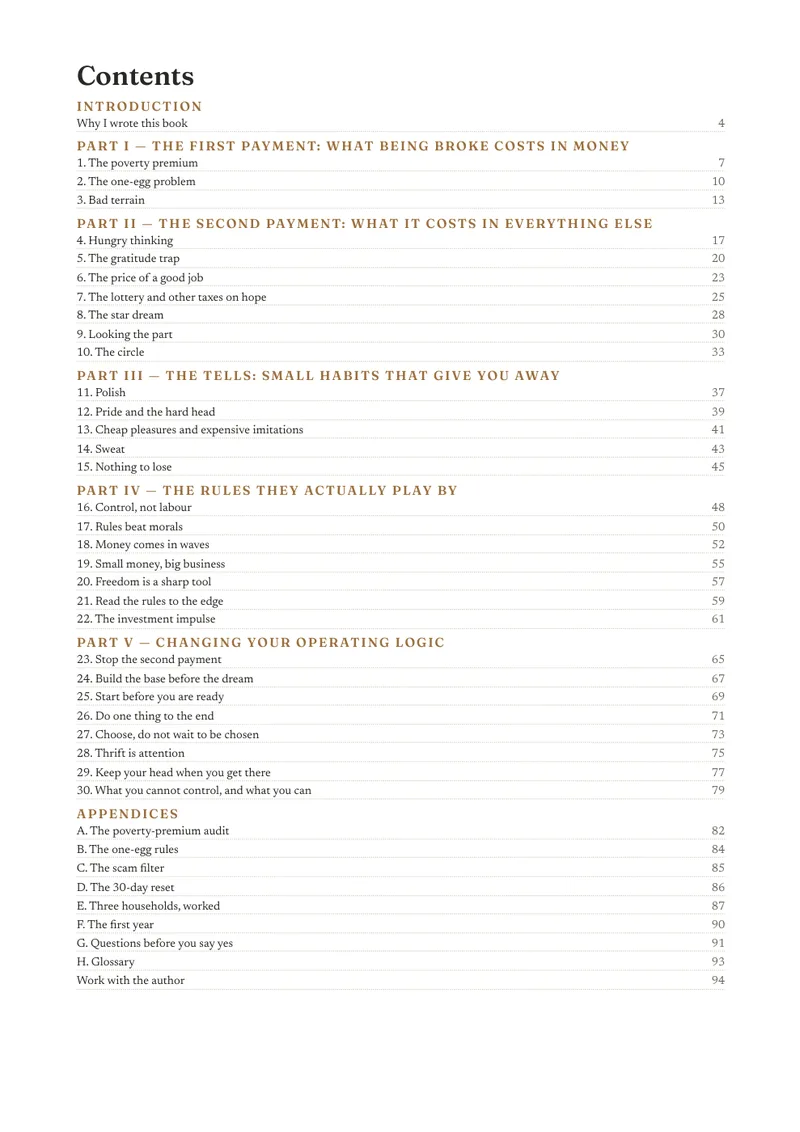
A twenty-line audit that puts a number on what being broke cost you last year. Most people are shocked, and most of it is avoidable.
Protect the egg before you grow the chick
The ten rules for small capital: what a first lump is for, what never to fund, and why the first stage is a different job from the rest.
Recognise every tax on hope
The twelve-question scam filter, the thirty-percent scheme explained, and the one sentence that stops you reaching for your wallet.
Read the rules to the edge
The four documents that govern most of a life’s money, read in four evenings, with the cheap channels that enforce them.
Inside the book
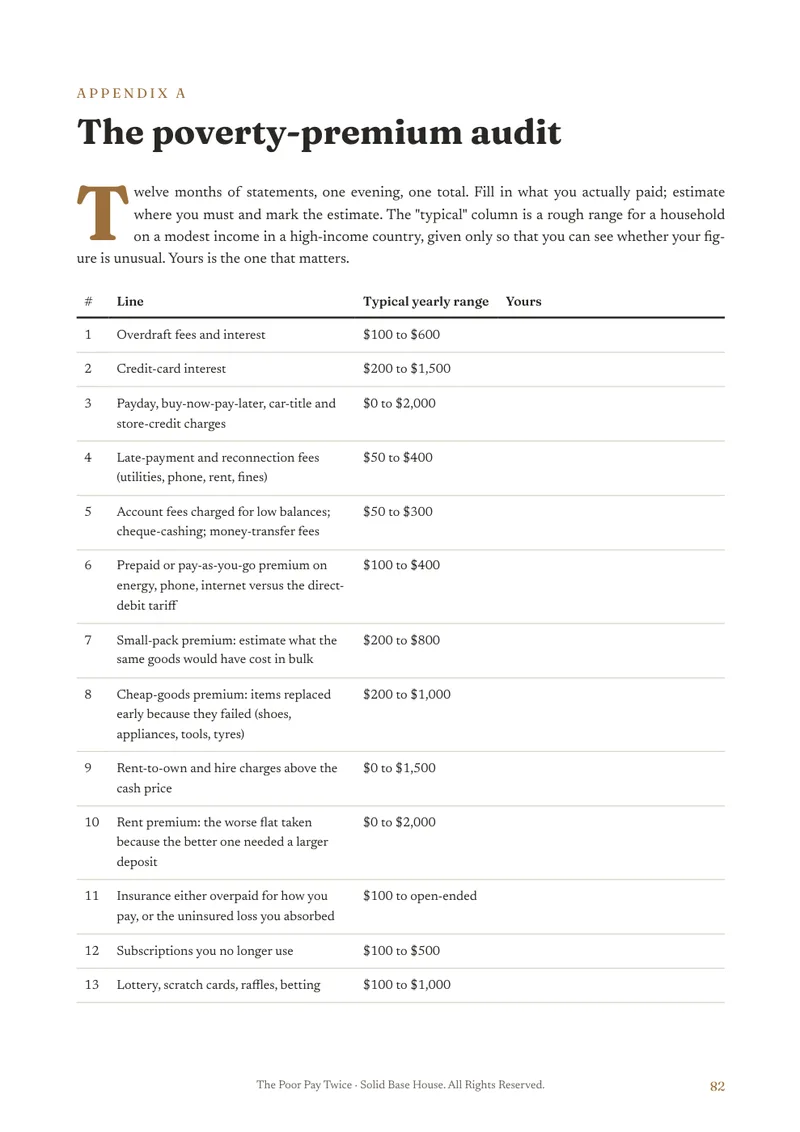
Five parts, thirty chapters, eight appendices
- IThe first payment: what being broke costs in money
- IIThe second payment: what it costs in everything else
- IIIThe tells: small habits that give you away
- IVThe rules they actually play by
- VChanging your operating logic
Show all 30 chapters
- 01The poverty premium
- 02The one-egg problem
- 03Bad terrain
- 04Hungry thinking
- 05The gratitude trap
- 06The price of a good job
- 07The lottery and other taxes on hope
- 08The star dream
- 09Looking the part
- 10The circle
- 11Polish
- 12Pride and the hard head
- 13Cheap pleasures and expensive imitations
- 14Sweat
- 15Nothing to lose
- 16Control, not labour
- 17Rules beat morals
- 18Money comes in waves
- 19Small money, big business
- 20Freedom is a sharp tool
- 21Read the rules to the edge
- 22The investment impulse
- 23Stop the second payment
- 24Build the base before the dream
- 25Start before you are ready
- 26Do one thing to the end
- 27Choose, do not wait to be chosen
- 28Thrift is attention
- 29Keep your head when you get there
- 30What you cannot control, and what you can
- AThe poverty-premium audit
- BThe one-egg rules
- CThe scam filter
- DThe 30-day reset
- EThree households, worked
- FThe first year
- GQuestions before you say yes
- HGlossary
The poor pay twice.
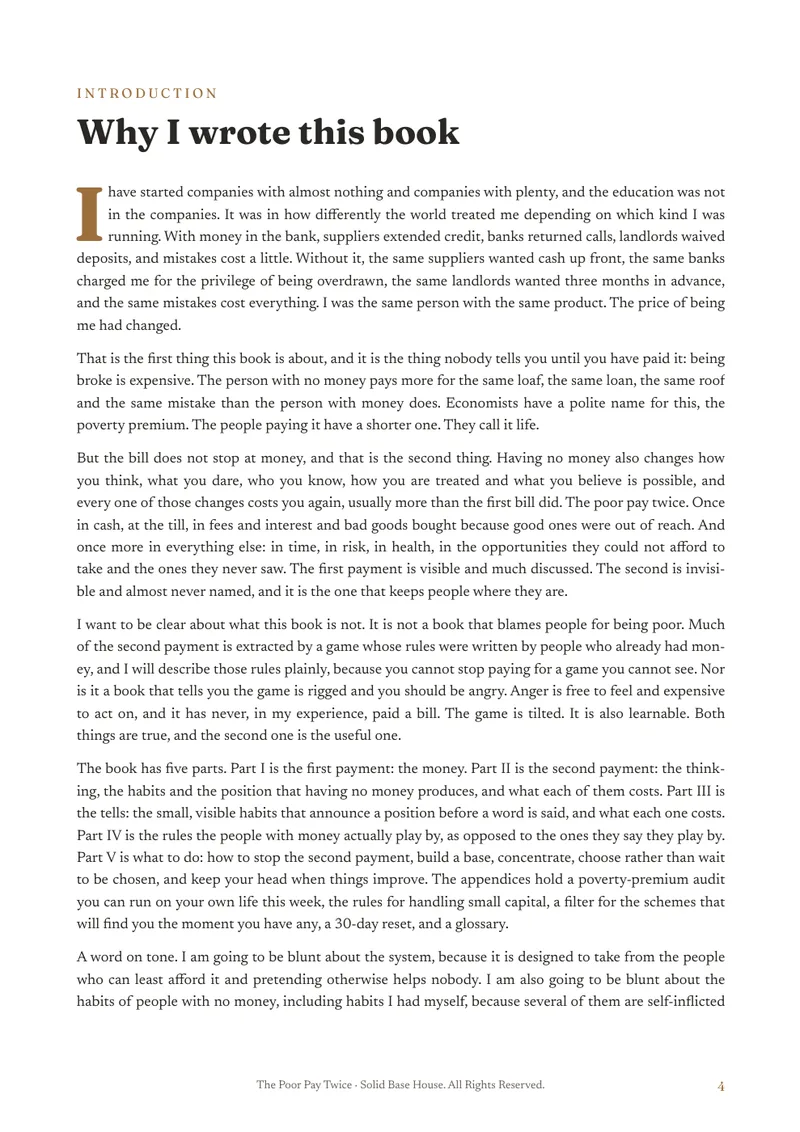
I have started companies with almost nothing and companies with plenty, and the education was not in the companies. It was in how differently the world treated me depending on which kind I was running. With money in the bank, suppliers extended credit, banks returned calls, landlords waived deposits, and mistakes cost a little. Without it, the same suppliers wanted cash up front, the same banks charged me for being overdrawn, and the same mistakes cost everything.
The poor pay twice. Once in cash, at the till, in fees and interest and bad goods bought because good ones were out of reach. And once more in everything else: in time, in risk, in health, in the opportunities they could not afford to take and the ones they never saw. The first payment is visible and much discussed. The second is invisible, almost never named, and it is the one that keeps people where they are.
Get the book
Stop paying the second bill
The complete PDF
US$29.99One payment. PDF, yours to keep.
All thirty chapters and the eight appendices: the audit, the one-egg rules, the scam filter, the 30-day reset, three worked households, the first year, the questions before you say yes, and the glossary. 95 A4 pages, typeset to read on a tablet or print. Delivered by email.
Buy the bookBook + 45-minute money reset call
US$229.99For your own numbers.
The PDF, plus a private 45-minute call with the author on your completed audit: what to stop first, the reserve, the debts, the cover, and the one thing to build next, followed by a one-page written plan for the next ninety days.
Book the callSeven-day guarantee
If the book doesn’t show you at least one charge you can stop paying this month, reply to the delivery email within seven days and the price is refunded. Keep the PDF.
Both options are sold through Payhip’s secure checkout. The PDF downloads instantly. After buying the call, you complete the audit in Appendix A, reply to the delivery email with the total, and pick a time on the booking calendar.
When you want a second pair of eyes
Work directly with the author
Ludovic Chan has spent more than 25 years in business and consulting, and has built and sold more than a dozen companies in Hong Kong, Canada and Japan, several of them from almost nothing. If you have run the audit and the number is larger than you can see a way out of, or you have named the thing you could own and do not know whether it is a business, start with a short email.
Before you buy
Questions readers ask
Is this a book about budgeting?
Only in one chapter. It is a book about the logic that keeps people broke: what the system charges them, what their position costs them, and the rules the wealthy use instead. The audit and the 30-day reset are practical, but the point of the book is to change where you sit, not how you count.
Does it blame the poor?
No. It is blunt about the system, which is built to take from the people who can least afford it, and blunt about the habits of the broke, several of which are self-inflicted and therefore the only ones entirely within your power to change. Both halves are in it. Readers who want only one will find it uncomfortable.
Does it work outside the United States?
Yes. The poverty premium, the one-egg problem and the rules in Part IV do not depend on any country, and the examples are deliberately general. Fees, interest rates and consumer protections differ by country; the book says where to check and the figures are shown as illustrative ranges in US dollars.
Why US$29.99 for a PDF?
Because the audit in Appendix A, run once, typically finds a four-figure sum in avoidable charges, and the book is the price of one of them. And if it doesn’t show you at least one charge you can stop paying this month, you get your money back.
What is the money reset call?
You complete the twenty-line audit and send the total; the author then spends 45 minutes with you on what to stop first, how to build the reserve, which debt to clear, what cover to buy and the one thing to build next, and sends a one-page written plan for the next ninety days. It is not investment advice or debt counselling.
I have already read Rich People Don’t Explain. Is this different?
Yes. That book is about how the wealthy think. This one is about what having no money costs, in two currencies, and how to stop the avoidable half of the bill. It is written for the reader on the other side of the table.