Chapter 1
Read the first chapter
The opening pages of every book from the House, newest first. Read them here, then decide.
The Middleman Always Eats
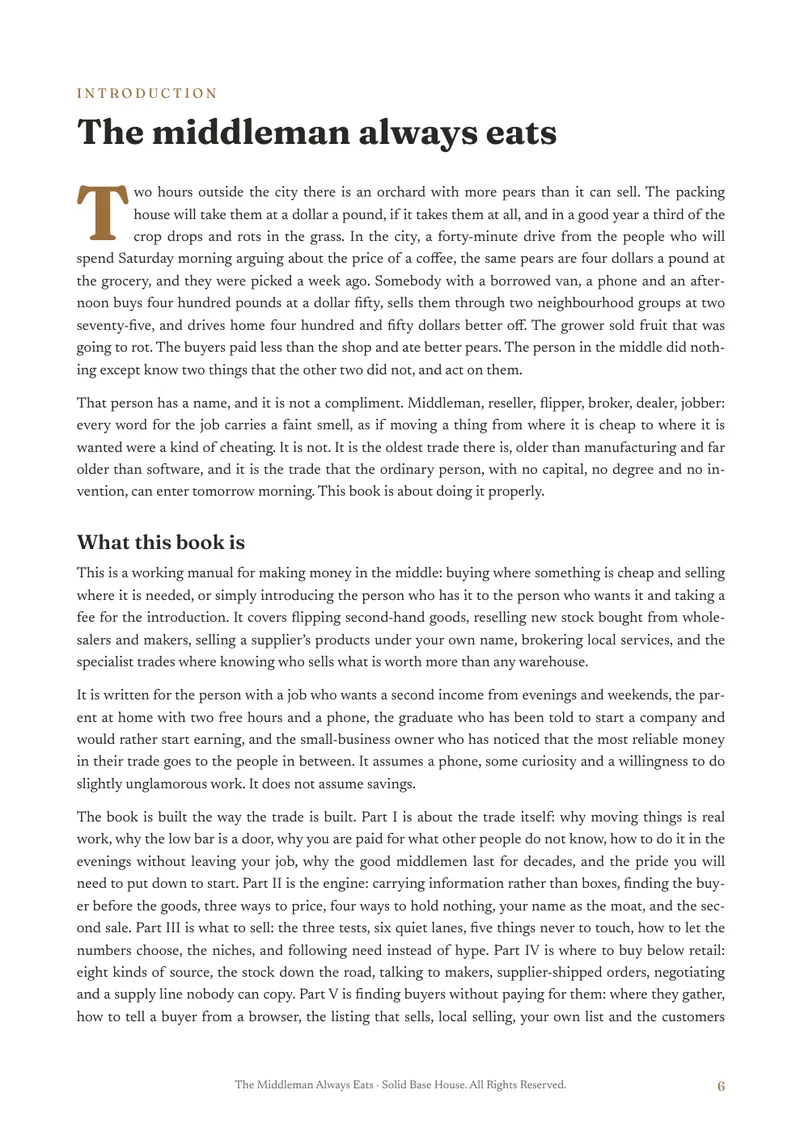
The middleman always eats
Two hours outside the city there is an orchard with more pears than it can sell. The packing house will take them at a dollar a pound, if it takes them at all, and in a good year a third of the crop drops and rots in the grass. In the city, a forty-minute drive away, the same pears are four dollars a pound at the grocery, and they were picked a week ago.
Somebody with a borrowed van, a phone and an afternoon buys four hundred pounds at a dollar fifty, sells them through two neighbourhood groups at two seventy-five, and drives home four hundred and fifty dollars better off. The person in the middle did nothing except know two things the other two did not, and act on them. That is the oldest trade there is, and the one an ordinary person can enter tomorrow morning.
One Person, Ten Jobs
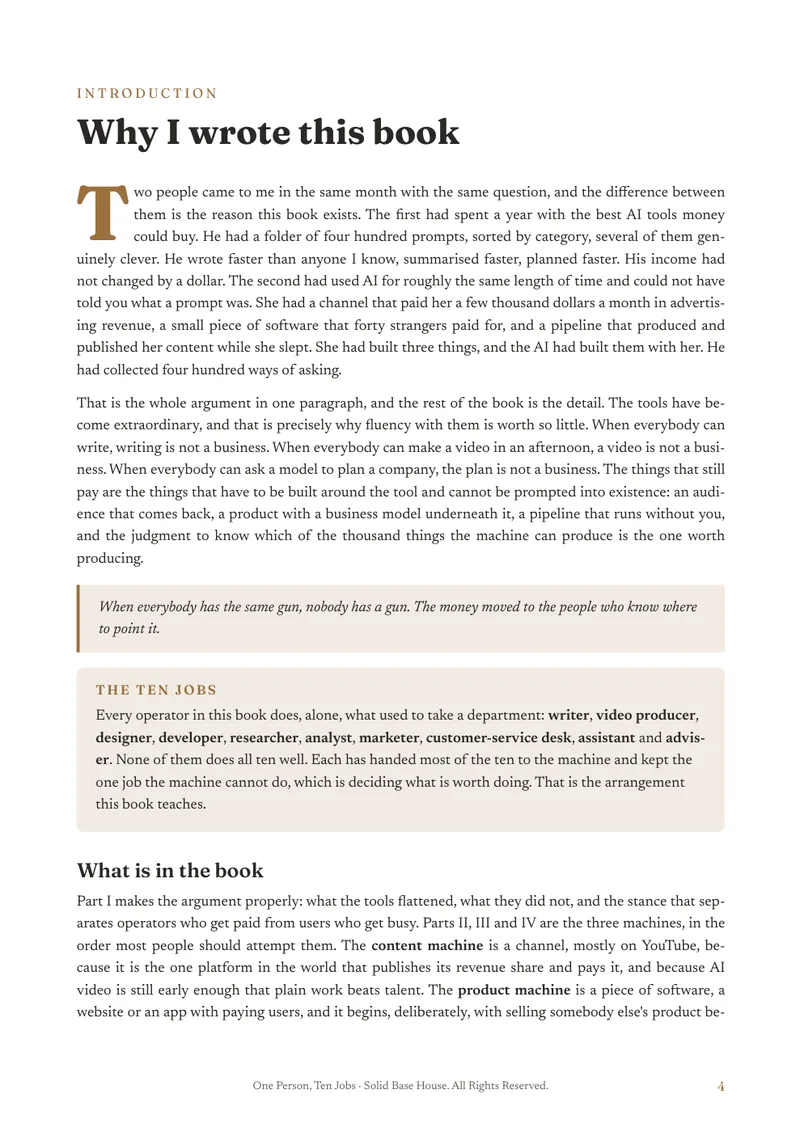
He had collected four hundred ways of asking. She had built three things.
Two people came to me in the same month with the same question, and the difference between them is the reason this book exists. The first had spent a year with the best AI tools money could buy. He had a folder of four hundred prompts, sorted by category, several of them genuinely clever. He wrote faster than anyone I know, summarised faster, planned faster. His income had not changed by a dollar. The second had used AI for roughly the same length of time and could not have told you what a prompt was. She had a channel that paid her a few thousand dollars a month in advertising revenue, a small piece of software that forty strangers paid for, and a pipeline that produced and published her content while she slept. She had built three things, and the AI had built them with her. He had collected four hundred ways of asking.
That is the whole argument in one paragraph, and the rest of the book is the detail. The tools have become extraordinary, and that is precisely why fluency with them is worth so little. When everybody can write, writing is not a business. When everybody can make a video in an afternoon, a video is not a business. When everybody can ask a model to plan a company, the plan is not a business. The things that still pay are the things that have to be built around the tool and cannot be prompted into existence: an audience that comes back, a product with a business model underneath it, a pipeline that runs without you, and the judgment to know which of the thousand things the machine can produce is the one worth producing.
Your Phone Is a Shop
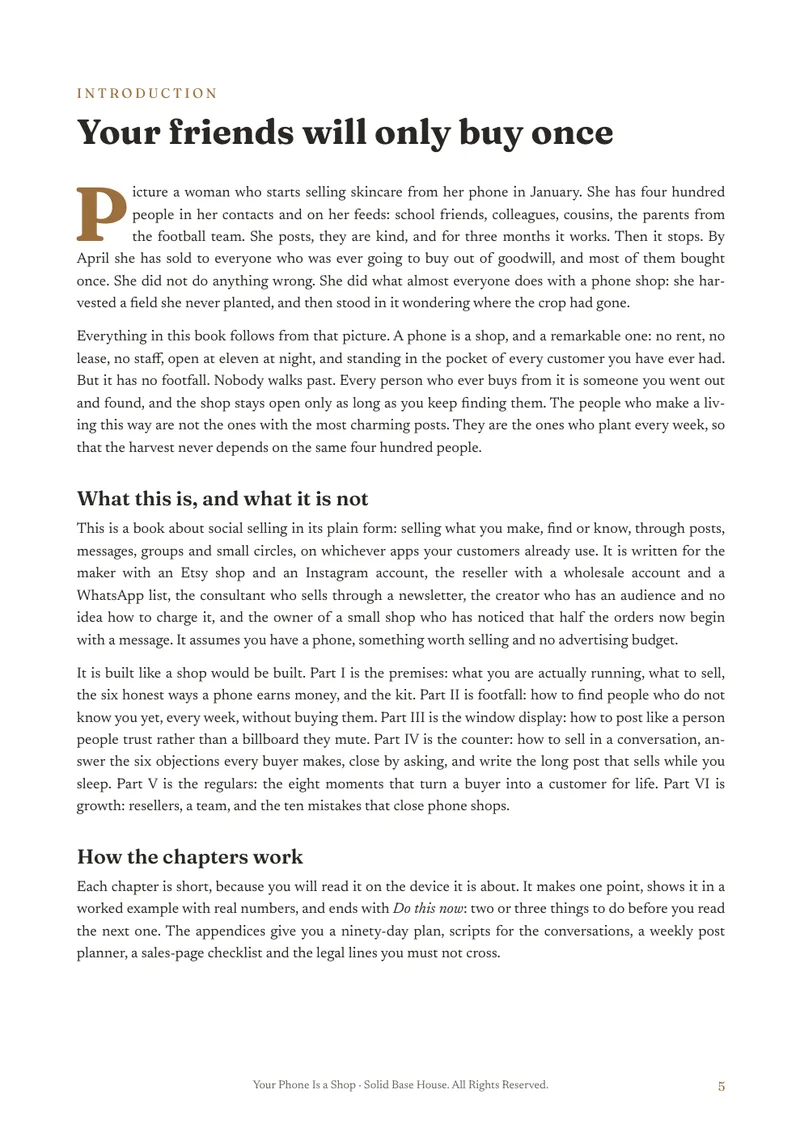
Your friends will only buy once
Picture a woman who starts selling skincare from her phone in January. She has four hundred people in her contacts and on her feeds: school friends, colleagues, cousins, the parents from the football team. She posts, they are kind, and for three months it works. Then it stops. By April she has sold to everyone who was ever going to buy out of goodwill, and most of them bought once.
A phone is a shop, and a remarkable one: no rent, no lease, no staff, open at eleven at night, and standing in the pocket of every customer you have ever had. But it has no footfall. Nobody walks past. Every person who ever buys from it is someone you went out and found, and the shop stays open only as long as you keep finding them.
Somebody Else Pays
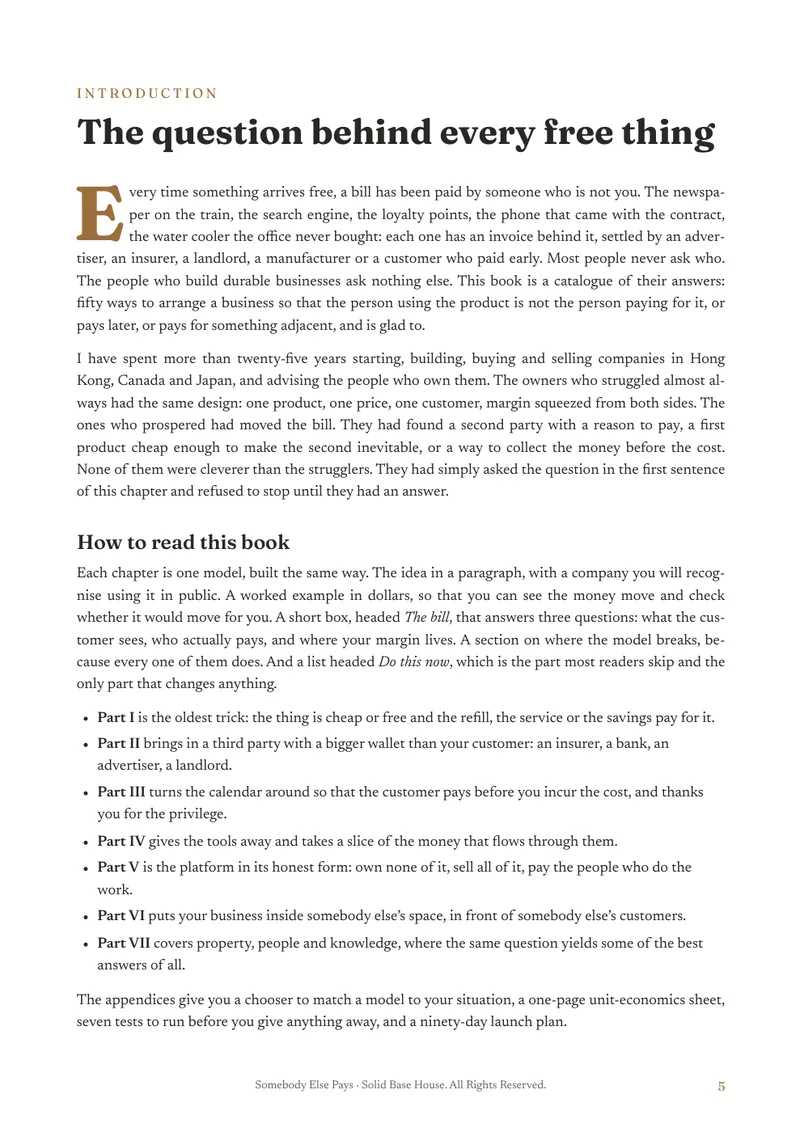
The question behind every free thing
Every time something arrives free, a bill has been paid by someone who is not you. The newspaper on the train, the search engine, the loyalty points, the phone that came with the contract, the water cooler the office never bought: each one has an invoice behind it, settled by an advertiser, an insurer, a landlord, a manufacturer or a customer who paid early. Most people never ask who. The people who build durable businesses ask nothing else.
The owners who struggled almost always had the same design: one product, one price, one customer, margin squeezed from both sides. The ones who prospered had moved the bill. They had found a second party with a reason to pay, a first product cheap enough to make the second inevitable, or a way to collect the money before the cost. None of them were cleverer than the strugglers. They had simply asked the question and refused to stop until they had an answer.
Lose Money on Purpose
I was competing on price with a man who was not charging.
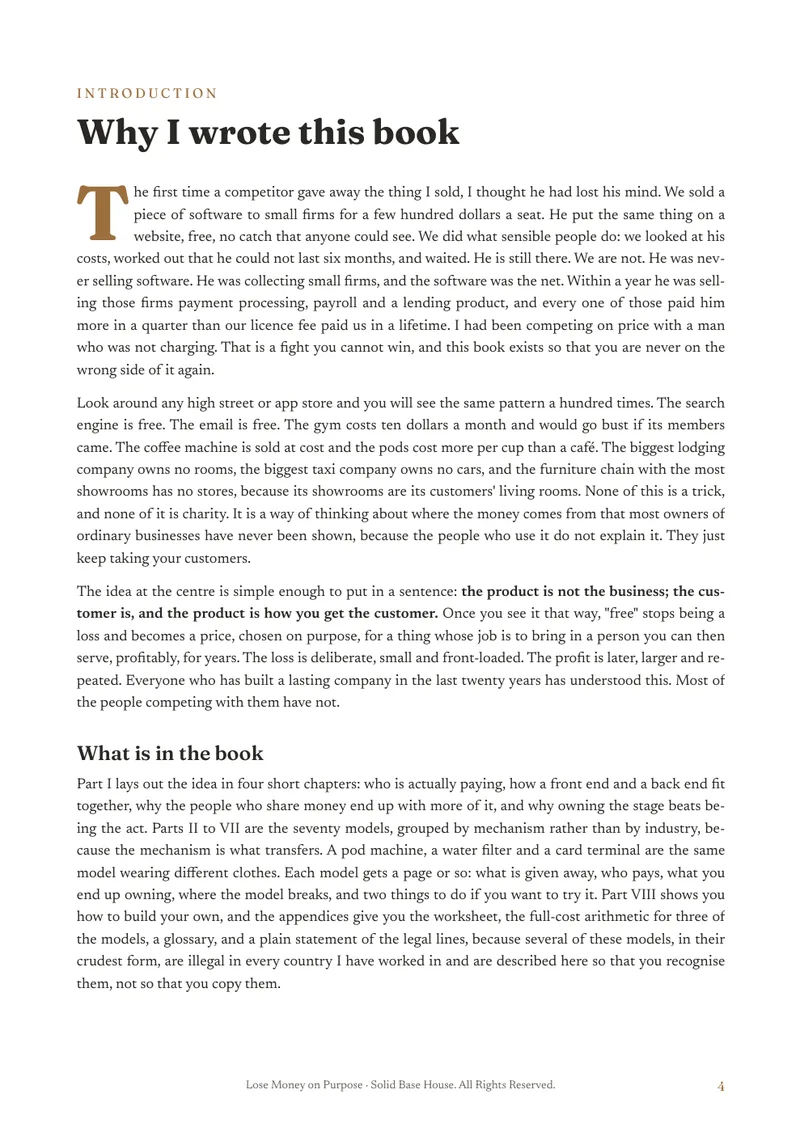
The first time a competitor gave away the thing I sold, I thought he had lost his mind. We sold a piece of software to small firms for a few hundred dollars a seat. He put the same thing on a website, free, no catch that anyone could see. We did what sensible people do: we looked at his costs, worked out that he could not last six months, and waited. He is still there. We are not.
He was never selling software. He was collecting small firms, and the software was the net. Within a year he was selling those firms payment processing, payroll and a lending product, and every one of those paid him more in a quarter than our licence fee paid us in a lifetime. I had been competing on price with a man who was not charging. That is a fight you cannot win, and this book exists so that you are never on the wrong side of it again.
Everything Is for Sale
A business is not a product.
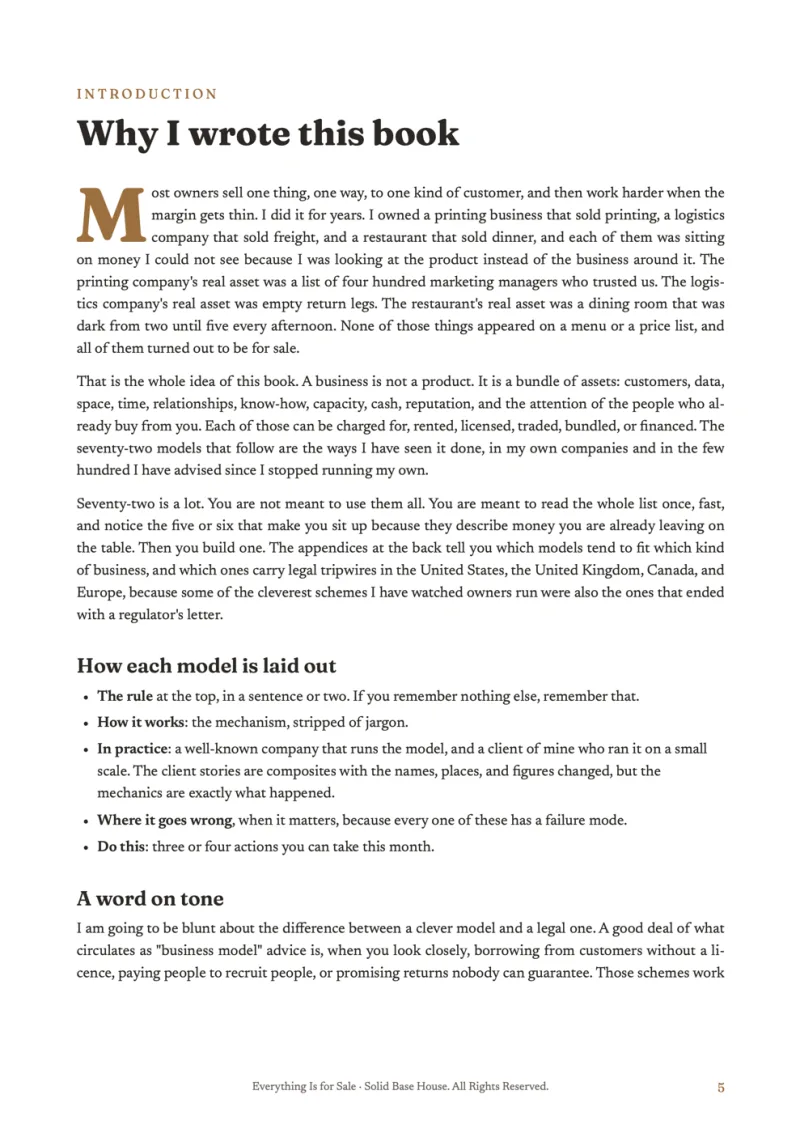
Most owners sell one thing, one way, to one kind of customer, and then work harder when the margin gets thin. I did it for years. I owned a printing business that sold printing, a logistics company that sold freight, and a restaurant that sold dinner, and each of them was sitting on money I could not see because I was looking at the product instead of the business around it.
A business is a bundle of assets: customers, data, space, time, relationships, know-how, capacity, cash, reputation, and the attention of the people who already buy from you. Each of those can be charged for, rented, licensed, traded, bundled, or financed. The seventy-two models that follow are the ways I have seen it done. You are not meant to use them all. You are meant to notice the five or six that describe money you are already leaving on the table, and build one.
The Poor Pay Twice
The poor pay twice.
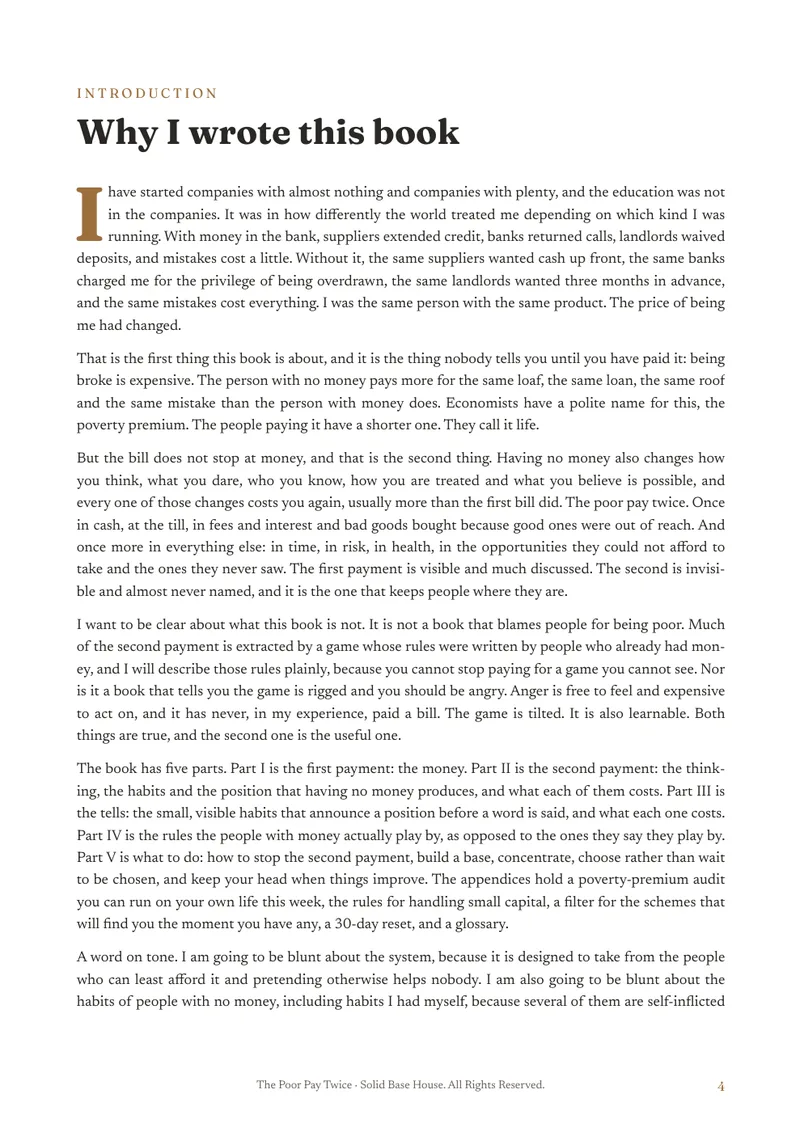
I have started companies with almost nothing and companies with plenty, and the education was not in the companies. It was in how differently the world treated me depending on which kind I was running. With money in the bank, suppliers extended credit, banks returned calls, landlords waived deposits, and mistakes cost a little. Without it, the same suppliers wanted cash up front, the same banks charged me for being overdrawn, and the same mistakes cost everything.
The poor pay twice. Once in cash, at the till, in fees and interest and bad goods bought because good ones were out of reach. And once more in everything else: in time, in risk, in health, in the opportunities they could not afford to take and the ones they never saw. The first payment is visible and much discussed. The second is invisible, almost never named, and it is the one that keeps people where they are.
Pretty Is Not a Plan
Why a business advisor wrote this book
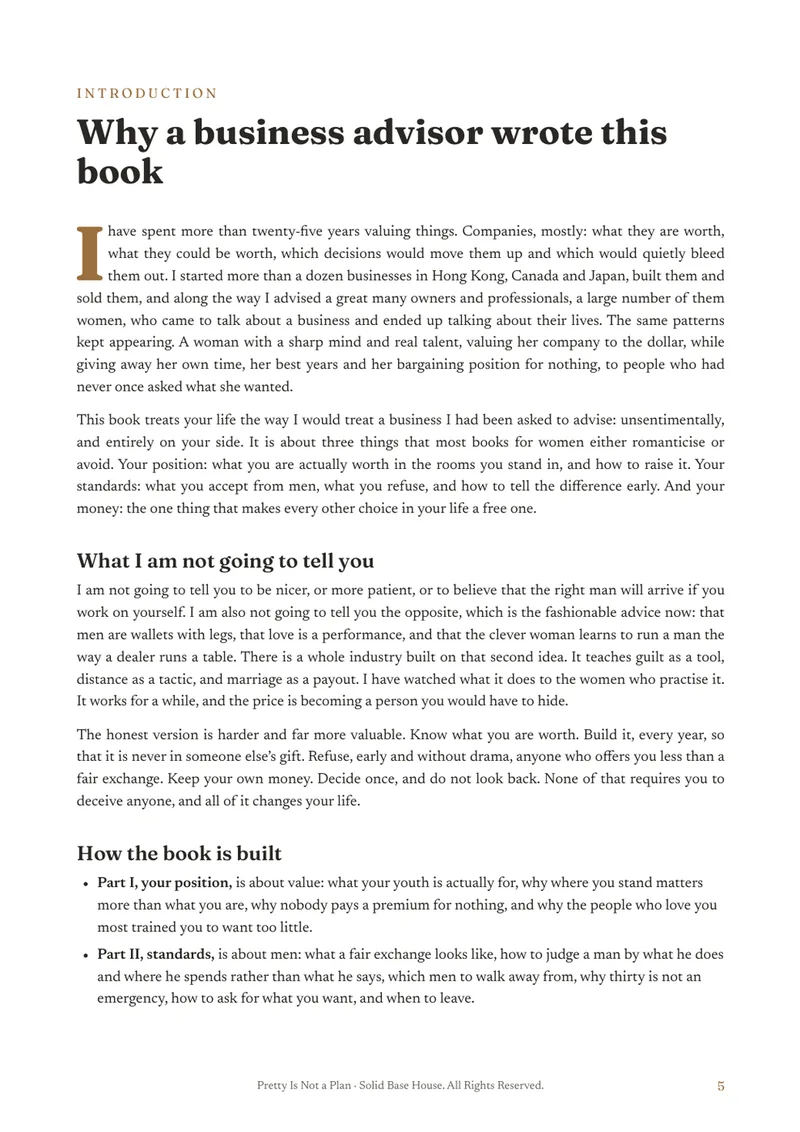
I have spent more than twenty-five years valuing things. Companies, mostly: what they are worth, what they could be worth, which decisions would move them up and which would quietly bleed them out. Along the way I advised a great many owners and professionals, a large number of them women, who came to talk about a business and ended up talking about their lives. The same patterns kept appearing. A woman with a sharp mind and real talent, valuing her company to the dollar, while giving away her own time, her best years and her bargaining position for nothing, to people who had never once asked what she wanted.
This book treats your life the way I would treat a business I had been asked to advise: unsentimentally, and entirely on your side. It is about three things that most books for women either romanticise or avoid. Your position. Your standards. And your money, the one thing that makes every other choice in your life a free one.
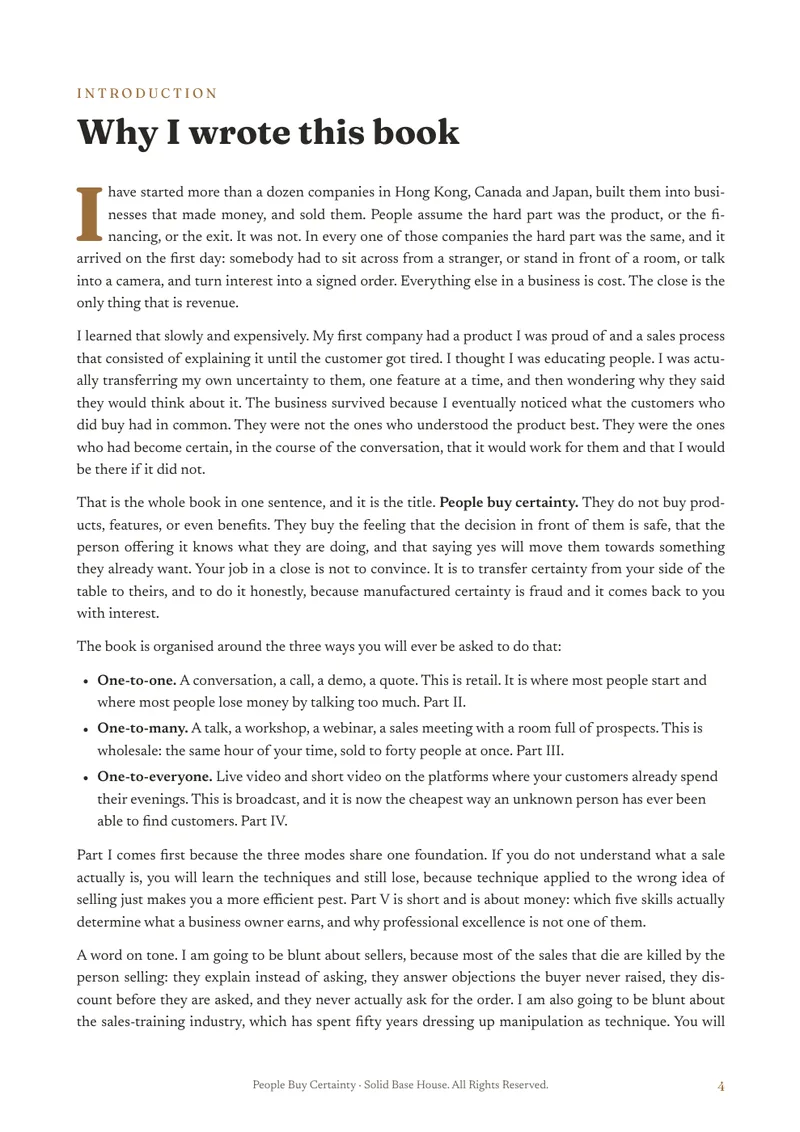
People Buy Certainty
The close is the only thing that is revenue.
I have started more than a dozen companies in Hong Kong, Canada and Japan, built them into businesses that made money, and sold them. People assume the hard part was the product, or the financing, or the exit. It was not. In every one of those companies the hard part was the same, and it arrived on the first day: somebody had to sit across from a stranger, or stand in front of a room, or talk into a camera, and turn interest into a signed order.
People buy certainty. They do not buy products, features, or even benefits. They buy the feeling that the decision in front of them is safe. Your job in a close is not to convince. It is to transfer certainty from your side of the table to theirs, and to do it honestly, because manufactured certainty is fraud and it comes back to you with interest.
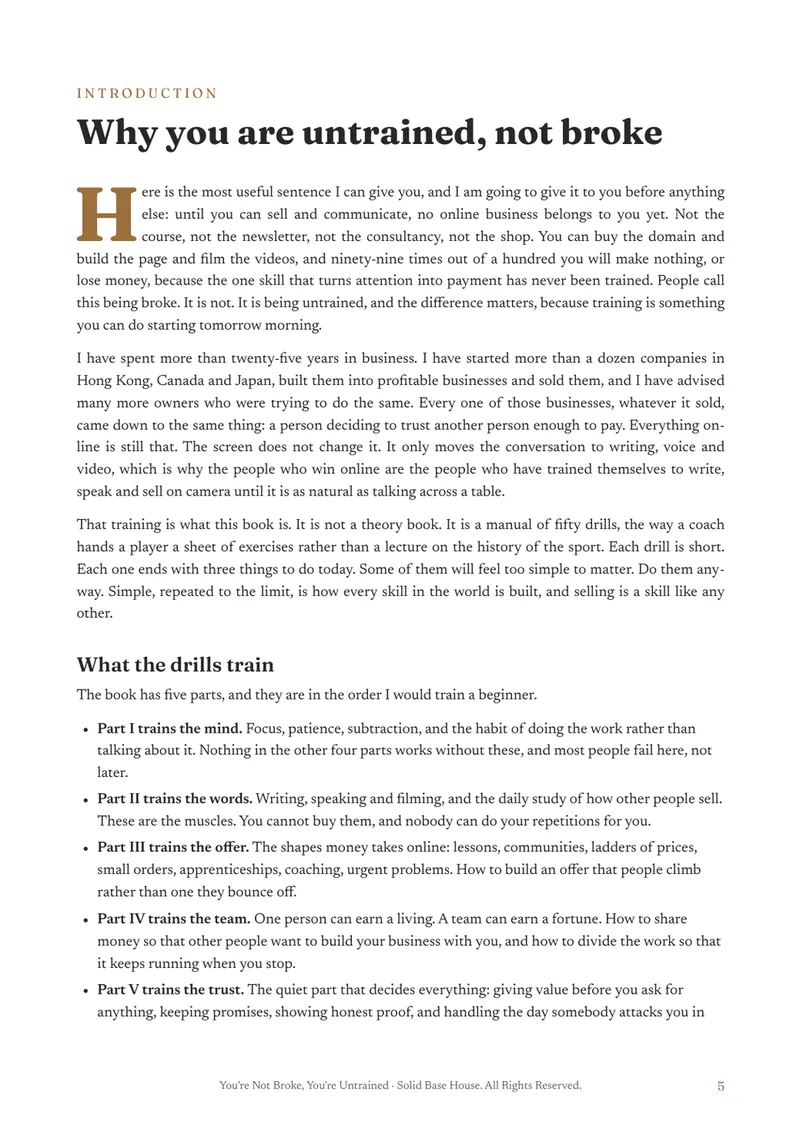
You’re Not Broke, You’re Untrained
Why you are untrained, not broke
Here is the most useful sentence I can give you, and I am going to give it to you before anything else: until you can sell and communicate, no online business belongs to you yet. Not the course, not the newsletter, not the consultancy, not the shop. You can buy the domain and build the page and film the videos, and ninety-nine times out of a hundred you will make nothing, or lose money, because the one skill that turns attention into payment has never been trained.
People call this being broke. It is not. It is being untrained, and the difference matters, because training is something you can do starting tomorrow morning. This book is not a theory book. It is a manual of fifty drills, the way a coach hands a player a sheet of exercises rather than a lecture on the history of the sport.
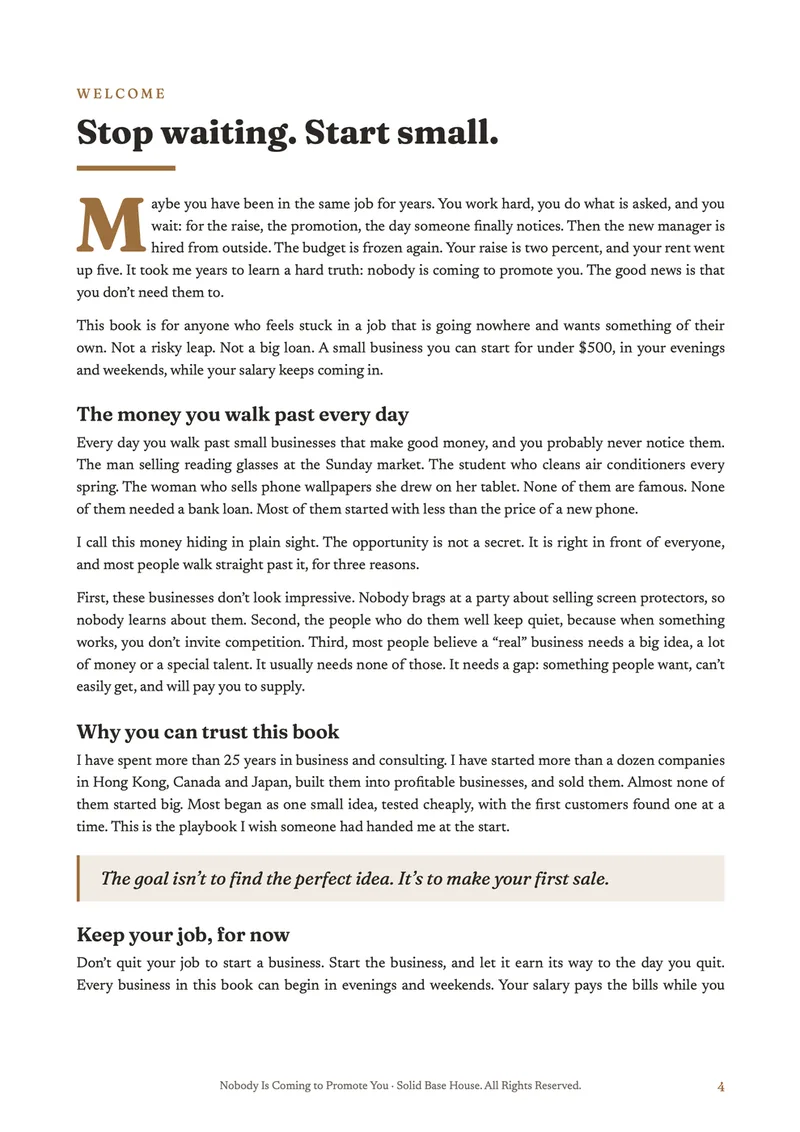
Nobody Is Coming to Promote You
Stop waiting. Start small.
Maybe you have been in the same job for years. You work hard, you do what is asked, and you wait: for the raise, the promotion, the day someone finally notices. Then the new manager is hired from outside. The budget is frozen again. Your raise is two percent, and your rent went up five. It took me years to learn a hard truth: nobody is coming to promote you. The good news is that you don’t need them to.
This book is for anyone who feels stuck in a job that is going nowhere and wants something of their own. Not a risky leap. Not a big loan. A small business you can start for under $500, in your evenings and weekends, while your salary keeps coming in.
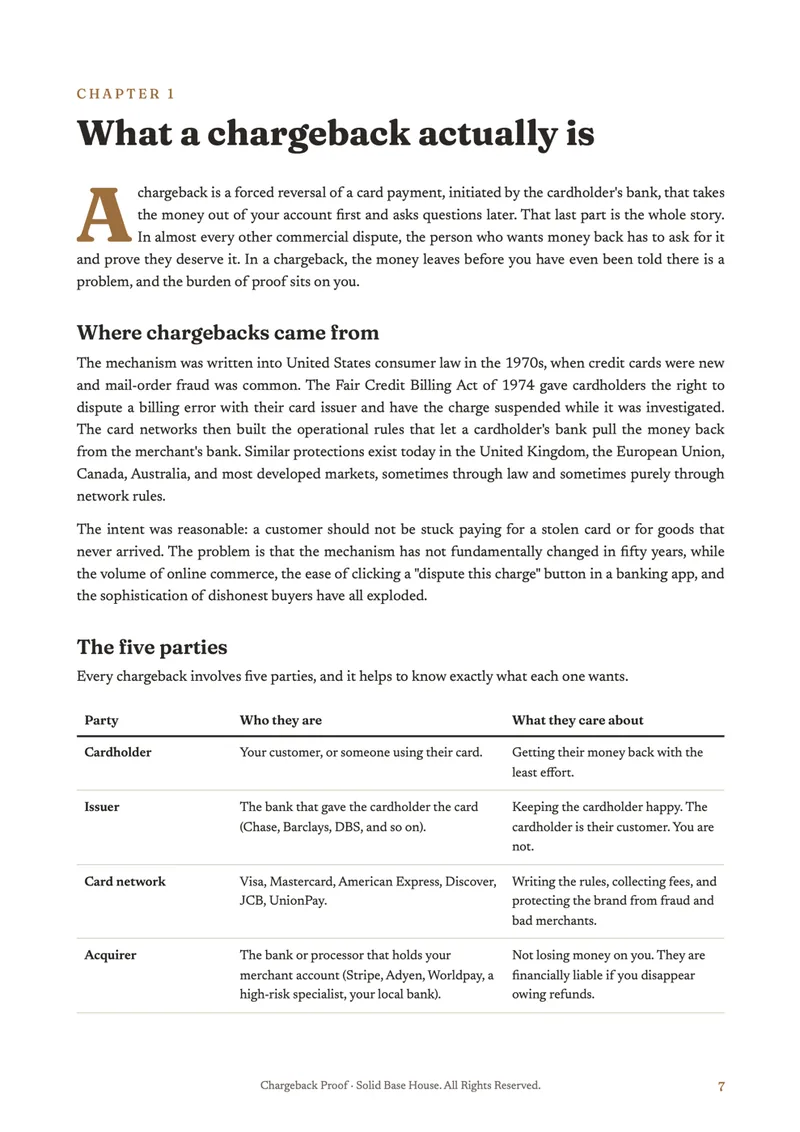
Chargeback Proof
What a chargeback actually is
A chargeback is a forced reversal of a card payment, initiated by the cardholder’s bank, that takes the money out of your account first and asks questions later. That last part is the whole story. In almost every other commercial dispute, the person who wants money back has to ask for it and prove they deserve it. In a chargeback, the money leaves before you have even been told there is a problem, and the burden of proof sits on you.
Notice that only one party in that list is on your side, and even they are only on your side until you become a risk to them. The acquirer is not your friend. The acquirer is your guarantor, and guarantors watch you closely.
Rich People Don’t Explain
Making Money Was Never About Getting Rich Overnight
Making money comes down to a way of thinking and relentless doing. Work, work, work. What did online sellers rely on to make money in the old days? Looking rich. What do they rely on now? Delivering value.
Never judge a person’s true character or true wealth by what they buy. Making money was never about getting rich overnight. For ordinary people like us it is a marathon, long and grinding, and what the race tests is persistence, resolve, brains, thinking, and breadth of experience.