Everything Is for Sale
72 ways to turn what your business already has into cash
Sound familiar?
You sell one thing, one way, and the margin keeps getting thinner.
This book is an inventory of the other doors. A business is a bundle of assets, and each of them can be charged for, rented, licensed, traded, bundled, or financed. Seventy-two models, one page each, with the company that runs it at scale, the owner who ran it in one town, and the version a regulator would shrug at.
The product is the whole business
Every dollar comes through one door, at one price, from one kind of customer. When that price is squeezed, there is nothing else to charge for.
Assets that earn nothing
A customer list, a dining room dark all afternoon, a van that comes back empty, data you collect to operate. Worth money to somebody, and nobody is paying.
Growth that needs a loan
The next location, the next machine, the next hire: each one waits for a bank, because the business has never been taught to collect before it delivers.
Clever schemes with a regulator attached
The consultant’s model that pays partners to recruit partners, holds customers’ money, or promises a return. It works until the letter arrives.
The book
A business is not a product. It is a bundle of things you can sell.
Most owners sell one thing, one way, to one kind of customer, and work harder when the margin gets thin. The printing company’s real asset was a list of four hundred marketing managers who trusted it. The logistics company’s real asset was its empty return legs. The restaurant’s real asset was a dining room that was dark from two until five. None of those things appeared on a price list, and all of them turned out to be for sale.
Part I is the shape of the business: staying light, riding a wave, rebuilding the value chain, owning the supply, alliances, licensing, subsidies paid by someone else, renting instead of selling, platforms and crossovers. Part II is capital: borrowing well, raising money from customers, borrowing against what you own, buying competitors with seller notes and earn-outs, building to sell, cash pools, invoice finance, property, bad debts and equity. Part III is product: the mix, moving upmarket, merchandise, time and geography arbitrage, scarcity and the hero product.
Part IV is people: talent, partners, incentives that change behaviour overnight, leadership, organisation, cutting waste and internal ventures. Part V is marketing as deal design: channels, bundles, membership, IP, cutting the market, partners, projects, reseller tiers, deposits, free, referral and human nature. Part VI is online: subscription, advertising, tips, traffic, users, fans, community, live selling, short video, value-added services, content, games, tasks, agency work, cashback, conversion, selling abroad, data and AI. Five appendices: the 72 on one page, which models fit which business, the nine legal lines, the 30-day plan and a glossary.
Who it is for
Owners of businesses that already have customers: restaurants, salons, clinics, trades, shops, online sellers, producers, distributors, professionals and multi-site operators. Not a book for a start-up looking for its first customer; a book for the owner who has customers and sells them one thing.
What changes after you read it
Four things you will do differently this month
Find the money you are already leaving on the table
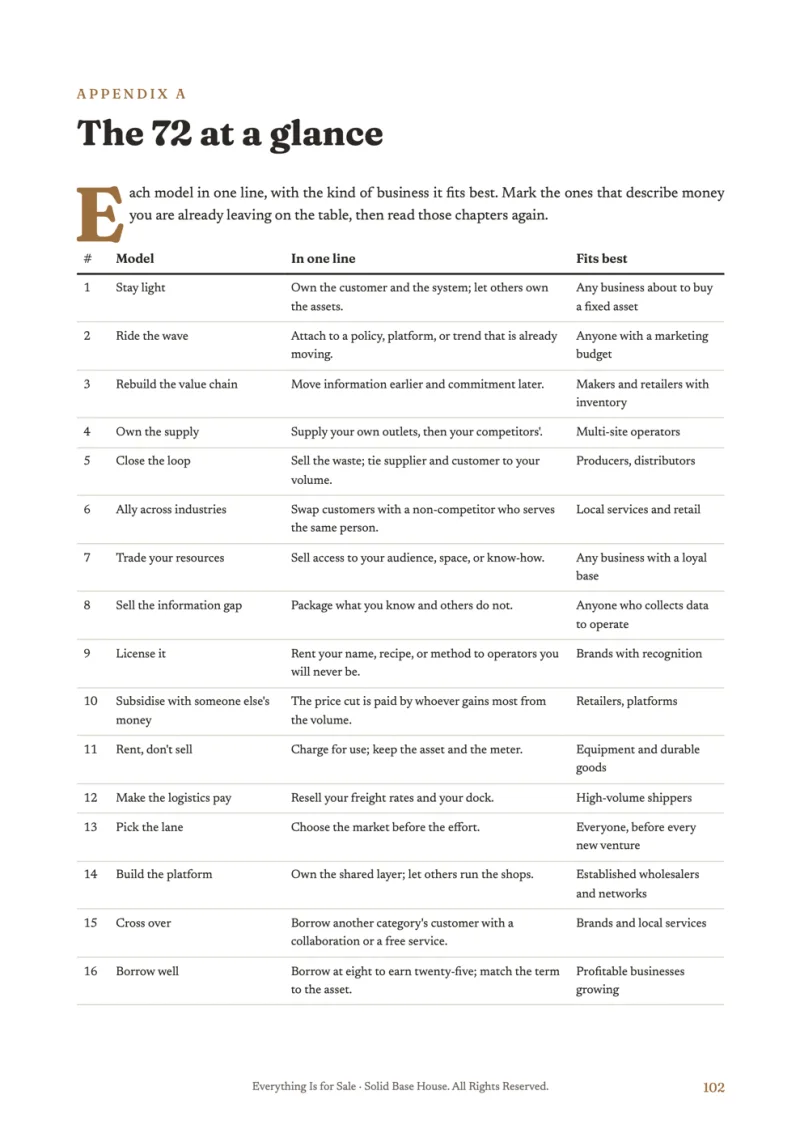
Appendix A puts all 72 models on one page. Read it once, fast, with a pen, and mark the five that describe money you are not collecting.
Collect before you deliver
Memberships, prepaid plans, deposits and projects that bring the year’s cash in January. The farm share, the hotel card, the salon deposit, the adopted tree.
Charge for what is not on the price list
Your audience, your freight rate, your data, your idle hours, your name. Models 7, 8, 9, 12, 24 and 71 are built on things you already own.
Stay on the right side of the line
Securities, deposits, pyramids, franchise rules, lending, referral fees, privacy. Appendix C explains each in plain words and gives the version that works.
Inside the book
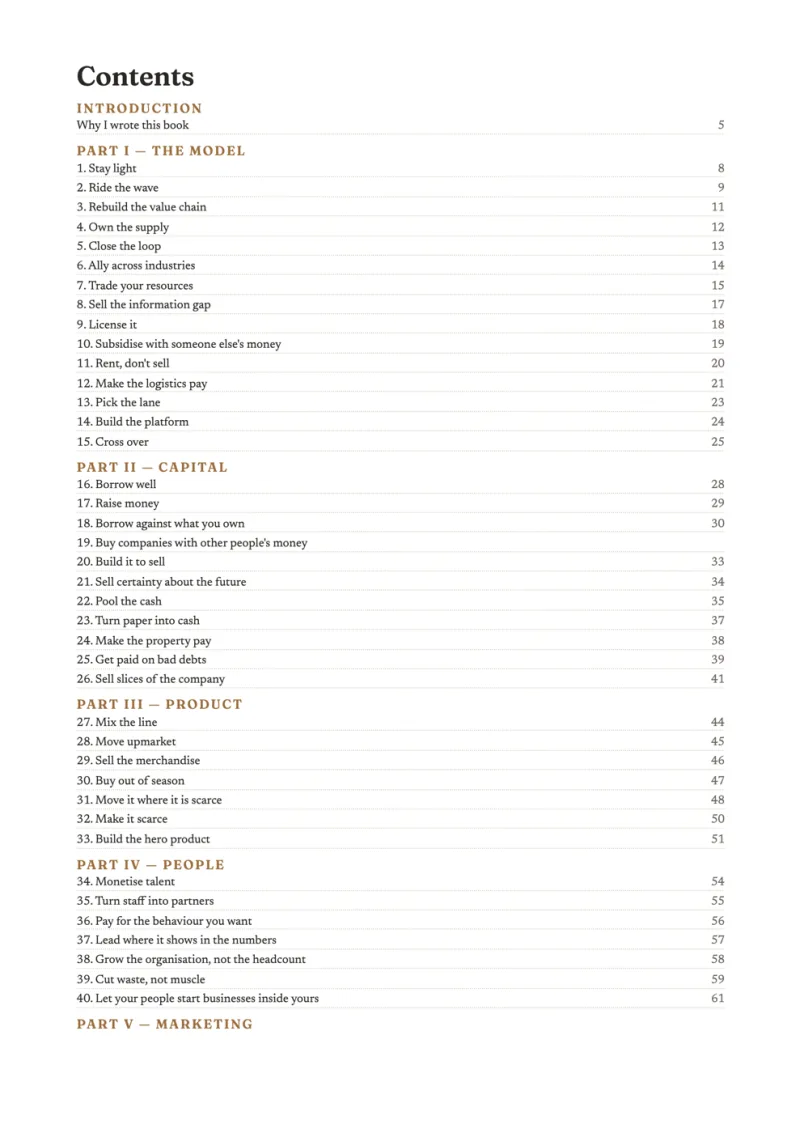
Six parts, seventy-two models, five appendices
- IThe model
- IICapital
- IIIProduct
- IVPeople
- VMarketing
- VIOnline
Show all 72 models
- 01Stay light
- 02Ride the wave
- 03Rebuild the value chain
- 04Own the supply
- 05Close the loop
- 06Ally across industries
- 07Trade your resources
- 08Sell the information gap
- 09License it
- 10Subsidise with someone else’s money
- 11Rent, don’t sell
- 12Make the logistics pay
- 13Pick the lane
- 14Build the platform
- 15Cross over
- 16Borrow well
- 17Raise money
- 18Borrow against what you own
- 19Buy companies with other people’s money
- 20Build it to sell
- 21Sell certainty about the future
- 22Pool the cash
- 23Turn paper into cash
- 24Make the property pay
- 25Get paid on bad debts
- 26Sell slices of the company
- 27Mix the line
- 28Move upmarket
- 29Sell the merchandise
- 30Buy out of season
- 31Move it where it is scarce
- 32Make it scarce
- 33Build the hero product
- 34Monetise talent
- 35Turn staff into partners
- 36Pay for the behaviour you want
- 37Lead where it shows in the numbers
- 38Grow the organisation, not the headcount
- 39Cut waste, not muscle
- 40Let your people start businesses inside yours
- 41Own the channel
- 42Bundle and co-sell
- 43Membership
- 44Build an IP
- 45Cut the market
- 46Recruit partners
- 47Sell the project, not the product
- 48Recruit resellers by tier
- 49Deposits
- 50Free
- 51Referral and fission
- 52Human nature
- 53Subscription
- 54Advertising
- 55Tips and priority
- 56Traffic
- 57Users
- 58Fans
- 59Community
- 60Live selling
- 61Short video
- 62Add value for free
- 63Sell what you know how to do
- 64Content
- 65Games
- 66Tasks and bounties
- 67Done-for-you operations
- 68Cashback and affiliates
- 69Promote to convert
- 70Sell abroad
- 71Data
- 72AI
- AThe 72 at a glance
- BWhich models fit your business
- CThe lines you must not cross
- DThe 30-day plan
- EGlossary
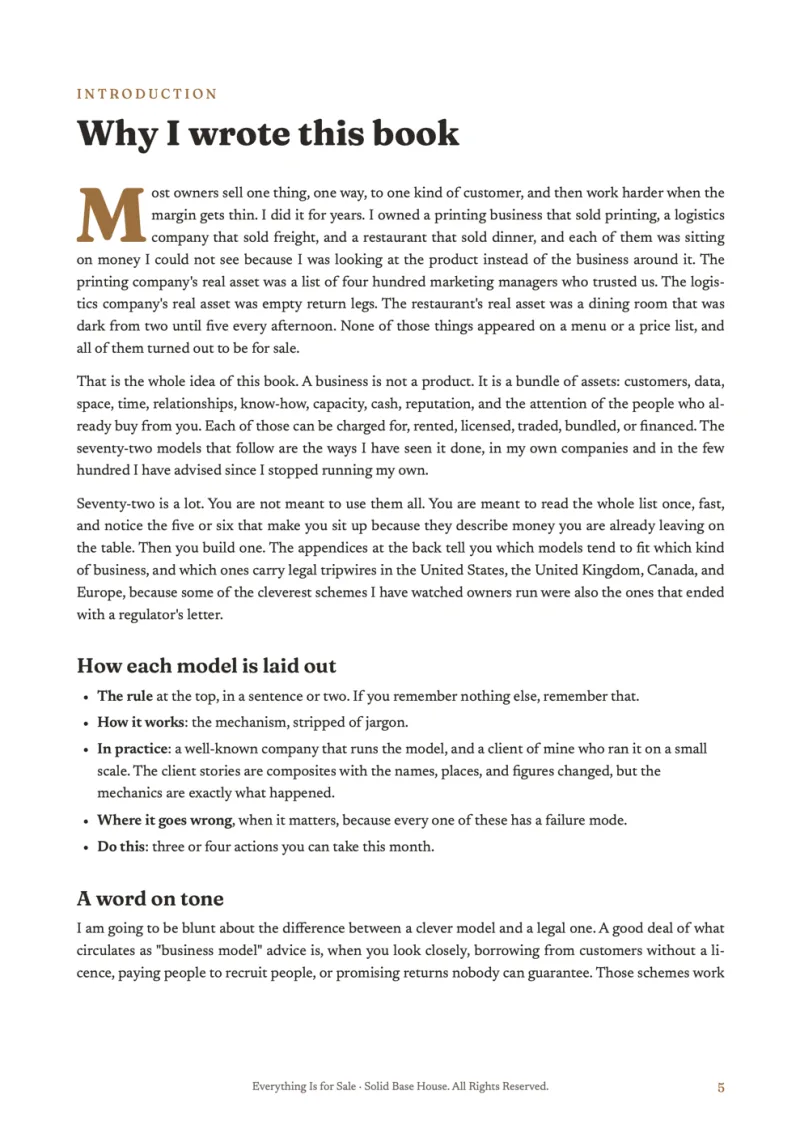
A business is not a product.
Most owners sell one thing, one way, to one kind of customer, and then work harder when the margin gets thin. I did it for years. I owned a printing business that sold printing, a logistics company that sold freight, and a restaurant that sold dinner, and each of them was sitting on money I could not see because I was looking at the product instead of the business around it.
A business is a bundle of assets: customers, data, space, time, relationships, know-how, capacity, cash, reputation, and the attention of the people who already buy from you. Each of those can be charged for, rented, licensed, traded, bundled, or financed. The seventy-two models that follow are the ways I have seen it done. You are not meant to use them all. You are meant to notice the five or six that describe money you are already leaving on the table, and build one.
Get the book
Open the other doors
The complete PDF
US$49.99One payment. PDF, yours to keep.
All seventy-two models and the five appendices: the one-page map, the fit guide by type of business, the nine legal lines, the 30-day plan and the glossary.
Buy the bookBook + 90-minute model-fit call
US$299.99For your own business.
The PDF, plus a private 90-minute call with the author on your numbers and your assets: the three models that fit your business, in order, the first step of each, and the legal check from Appendix C, followed by a one-page written summary.
Book the callSeven-day guarantee
If the book doesn’t show you at least one way to earn from something you already own, reply to the delivery email within seven days and the price is refunded. Keep the PDF.
Both options are sold through Payhip’s secure checkout. The PDF downloads instantly. After buying the call, you reply to the delivery email with a short description of your business and its numbers, and pick a time on the booking calendar.
When you want a second pair of eyes
Work directly with the author
Ludovic Chan has built, bought and sold more than a dozen companies across Asia and North America, and has spent the past decade advising owners who were selling one thing one way. If you have marked your five models and cannot decide which to build first, or a consultant has already sold you a scheme and you want to know where it stands, start with a short email.
Before you buy
Questions readers ask
Is this a book of business ideas?
No. It assumes you already have a business and customers. Each model is a way to earn more from what that business already has: its audience, its assets, its idle time, its data, its name, its relationships.
Are the examples real?
The named companies are real and discussed from public sources. The client stories are composites: names, places and figures changed, mechanics exactly as they happened.
Does it work outside the United States?
Yes. The models are the same in Britain, Canada, Australia and Europe. Appendix C notes where the rules differ: securities, deposits, franchise disclosure, lending, privacy.
Why US$49.99 for a PDF?
Because one model built from this book, a membership, a prepaid plan, a deposit scheme, a licence, typically earns the price back in the first week it runs. And if it doesn’t show you at least one way to earn from something you already own, you get your money back.
What is the model-fit call?
You send a short description of the business and its numbers. The author then spends 90 minutes with you choosing the three models that fit, in order, with the first step of each and the legal check, and sends a one-page written summary. It is not legal, tax or investment advice.
Some of these models sound like things that got people into trouble.
Several were first taught in a form that would be a crime where this book is sold: guaranteed returns, recruiting bonuses, customers’ money invested. Each has been rewritten in the version that works lawfully, and Appendix C lists the nine lines so you can see where they are.