Lose Money on Purpose
70 business models where the product is free and the profit is somewhere else
Sound familiar?
You sell a good product at a fair margin. Someone just gave it away.
This book shows you the mechanism underneath the companies that keep taking your customers: the product is not the business, the customer is, and the product is how you get the customer. Then it gives you seventy ways to do it, grouped by how the money moves rather than by industry, with the legal line drawn on every one that takes money before it delivers.
A competitor who does not need to charge
The bank that gives away the software you sell. The retailer that offers free delivery. They earn elsewhere, and your price war is with someone who is not charging.
The margin keeps shrinking
You cut ten percent, they cut twenty. A single-product business has one tool, and it is the one that ends with both shops dead.
You gather something you never sell
Every business collects people, visits, trust or a recurring need. Most owners sell the product and throw the gathered thing away.
Free looks like a loss
You tried a giveaway once, a crowd took it and nobody came back. Free works. Unconditional free does not, and nobody showed you the difference.
The book
Free is not a loss. Free is a price, chosen on purpose, for the thing whose job is to bring in the customer.
The coffee machine is sold at cost and the pods cost more per cup than a café. The gym charges ten dollars a month and would go bust if its members came. The biggest lodging company owns no rooms, and the furniture chain with the most showrooms has no stores, because its showrooms are its customers’ living rooms. None of this is a trick. It is a way of thinking about where the money comes from that most owners of ordinary businesses have never been shown.
Part I lays out the idea in four chapters: who is actually paying, how a front end feeds a back end, why the people who share the money end up with the most of it, and why owning the stage beats being the act. Parts II to VII are the seventy models: free hardware and paid refills, free software and paid supply, somebody else pays, prepaid money and the float, other people’s shops, and platforms. Each gets its own entry: what is given away, who pays, what you end up owning, where it breaks, how it works in other trades, and what to do now.
Part VIII shows you how to build your own: copy a model from an industry that has never met yours, answer the five questions, put a condition after the word “free”, and know which of the three ways money is made you are in. Five appendices give you the seventy at a glance, the ten-line worksheet, the regulated lines and their lawful shapes, three models fully costed, and a glossary. Several of the source models are deposit-taking or Ponzi arithmetic in their crude form; they are in the book so that you recognise them, with the legal version beside each.
Who it is for
Owners of small and mid-sized businesses, founders, and anyone whose product is being undercut by a competitor who does not need to make money on it. If you sell a thing at a margin and wonder why the margin keeps shrinking, this is the book.
What changes after you read it
Four things you will do differently this month
Answer the three questions
Who is the customer, who pays and when, and what do you own. If the third answer is “the product”, you now know what to change.
Price a front end
What a customer is worth later, and what share of the people who take the free thing become that customer. Two numbers, and a deliberate loss becomes a calculation.
Borrow a model from another trade
The lunch pass was the ten-dollar gym copied into food. The method in Chapter 5 finds the industry that already solved your pain.
Take money in advance without crossing the line
Prepaid product, gift credit, buy-backs with the fund secured: the lawful float. And the one-sentence test that separates it from a fraud.
Inside the book
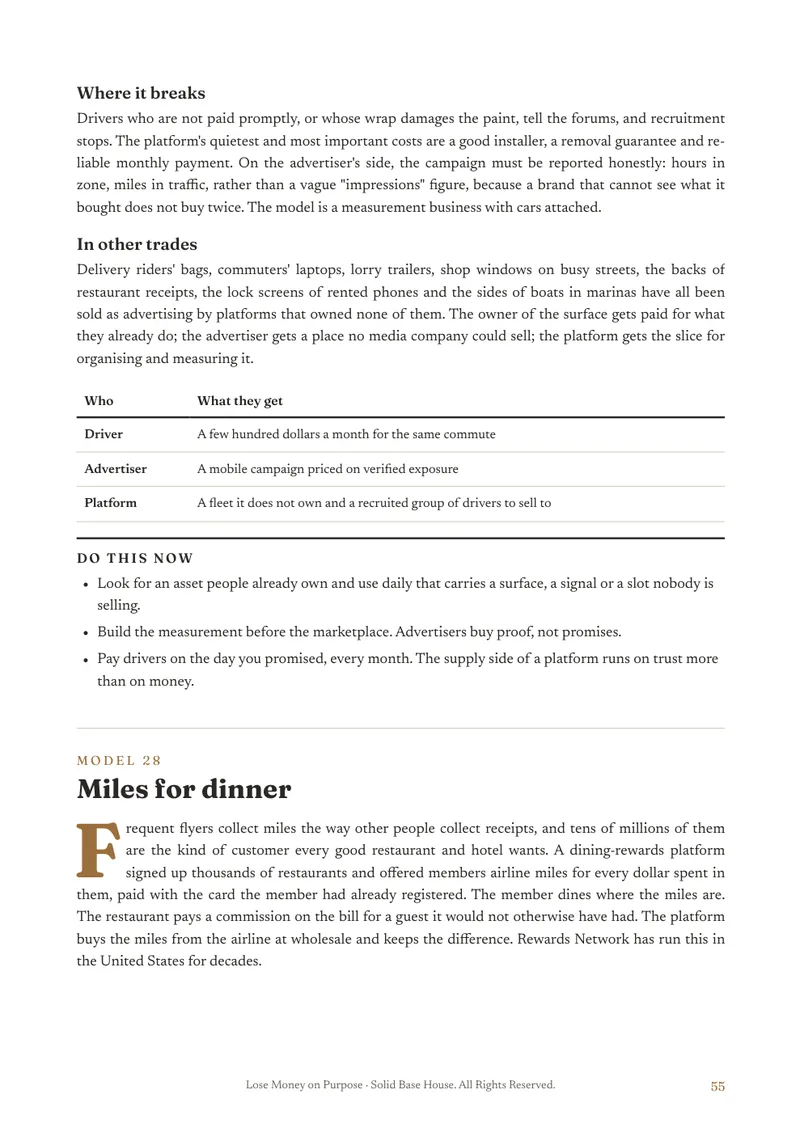
Eight parts, seventy models, five appendices
- IThe product is not the business
- IIFree hardware, paid refill
- IIIFree software, paid supply
- IVSomebody else pays
- VPrepaid money, deposits and the float
- VIOther people’s shops
- VIIOwn the stage: platforms
- VIIIBuild your own
Show all 70 models
- 01The pod machine
- 02The free water filter
- 03The metered air conditioner
- 04The free camera
- 05The free streaming box
- 06The grandparent watch
- 07The app-run washing machine
- 08The free card terminal
- 09The free skates
- 10The free display fridge
- 11The free restaurant till
- 12The free car-wash system
- 13The free baby-shop system
- 14The gym software that sells lunch
- 15The farm platform that sells feed
- 16The fertiliser recipe with no factory
- 17The salon platform
- 18The resident app
- 19The commission-only sales floor
- 20The owners’ academy
- 21The appliance the insurer paid for
- 22The double-margin bundle
- 23The gift at face value
- 24The free swim pass
- 25The free magazine
- 26Free Wi-Fi, three ways
- 27The wrapped car
- 28Miles for dinner
- 29The free car wash
- 30The free oil change
- 31The vegetable box sold a year ahead
- 32Adopt an olive tree
- 33Crowdfund the harvest
- 34Adopt a cow
- 35Adopt a hen
- 36The bonus gift card
- 37The restaurant that became a bank
- 38The full-refund television
- 39The buy-back guarantee
- 40The club that happens to sell jewellery
- 41The jewel with a yield
- 42The bank-referral gift
- 43The lease-option takeover
- 44The landlord who refunds the rent
- 45Zero rent, for ever
- 46The managed franchise
- 47The zero-interest driving school
- 48The free wedding
- 49The hotel that is a showroom
- 50The rental that is a showroom
- 51Your customer’s living room
- 52Flowers in the café
- 53Cosmetics on the salon shelf
- 54Snacks in the office
- 55The counter in the dead hours
- 56Stalls on private land
- 57The micro-shop mall
- 58The lease that pays you to stay
- 59The everywhere gym pass
- 60The lunch subscription
- 61The repair app
- 62Beauty through the hotel
- 63The cashback app
- 64The merchant alliance
- 65The driver’s card
- 66The playground pass
- 67Short-term retail
- 68The farm-stay platform
- 69The wedding magazine that charges vendors
- 70The renovation crew without a crew
- AThe 70 models at a glance
- BThe model worksheet
- CThe lines you cannot cross
- DThree models, fully costed
- EGlossary
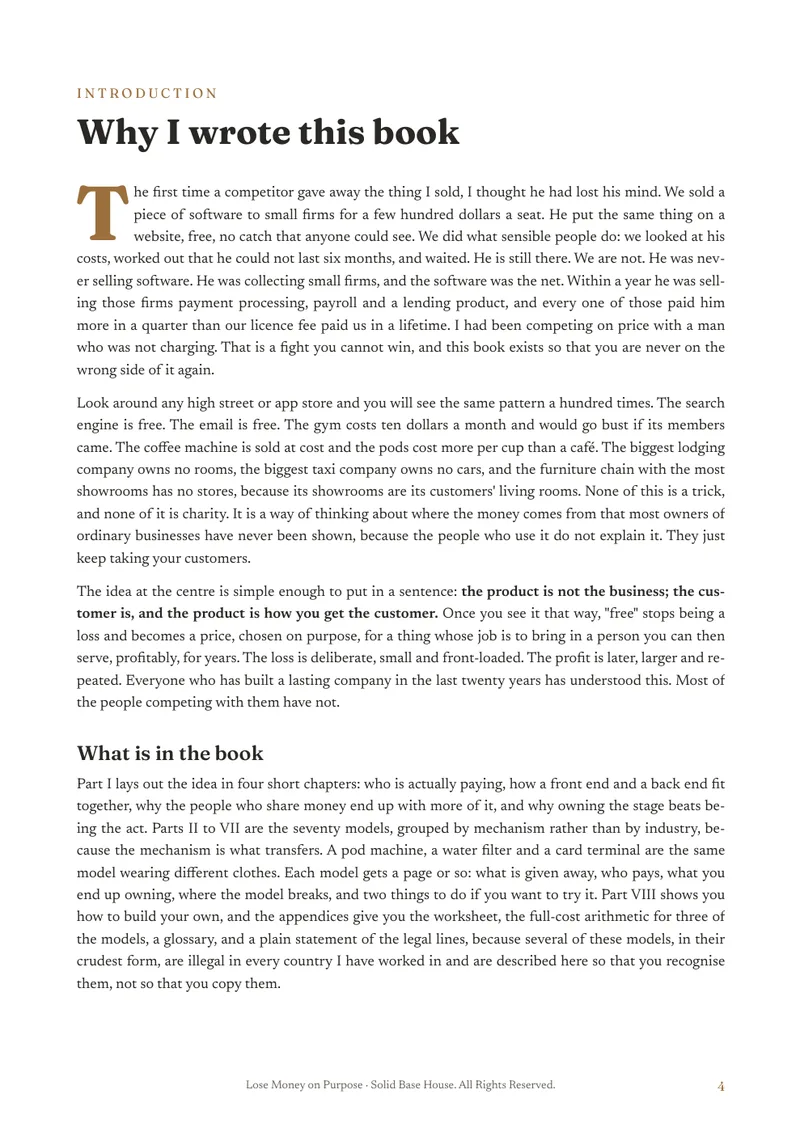
I was competing on price with a man who was not charging.
The first time a competitor gave away the thing I sold, I thought he had lost his mind. We sold a piece of software to small firms for a few hundred dollars a seat. He put the same thing on a website, free, no catch that anyone could see. We did what sensible people do: we looked at his costs, worked out that he could not last six months, and waited. He is still there. We are not.
He was never selling software. He was collecting small firms, and the software was the net. Within a year he was selling those firms payment processing, payroll and a lending product, and every one of those paid him more in a quarter than our licence fee paid us in a lifetime. I had been competing on price with a man who was not charging. That is a fight you cannot win, and this book exists so that you are never on the wrong side of it again.
Get the book
Stop being the one who charges for the door
The complete PDF
US$39.99One payment. PDF, yours to keep.
All eight parts, the seventy models and the five appendices: the models at a glance, the worksheet, the lines you cannot cross, three models fully costed, and the glossary. 141 A4 pages, typeset to read on a tablet or print. Delivered by email.
Buy the bookBook + 60-minute model design call
US$399.99For your own model.
The PDF, plus a private 60-minute call with the author on your completed worksheet: the carrier product and its condition, the attachment, the back end, the three winners, the two numbers to test, and the legal line, followed by a written one-page model you can build from.
Book the callSeven-day guarantee
If the book doesn’t give you at least one model you could test in your own business this quarter, reply to the delivery email within seven days and the price is refunded. Keep the PDF.
Both options are sold through Payhip’s secure checkout. The PDF downloads instantly. After buying the call, you fill in the worksheet in Appendix B, reply to the delivery email with it, and pick a time on the booking calendar.
When you want a second pair of eyes
Work directly with the author
Ludovic Chan has spent more than 25 years in business and consulting, and has built and sold more than a dozen companies in Hong Kong, Canada and Japan, several of them from almost nothing. If you have a model circled and want to know whether it is a business or a promotion, or a partner deal to structure, start with a short email.
Before you buy
Questions readers ask
Is this a book about startups?
No. Most of the seventy models were run by ordinary businesses: a bakery, a car wash, a landlord, a driving school, a flower seller, a hotel. The book is for anyone who sells something at a margin and wants to stop being the one who charges for the door.
Are the models legal?
Most are, as described, and each entry says what to watch. A handful, in their original form, are deposit-taking or Ponzi arithmetic and are illegal in the US, UK and EU; they are in the book so that you recognise them, with the lawful version beside each and the line drawn. Appendix C lists thirteen regulated activities and the lawful shape of every one.
Does it work outside the United States?
Yes. The mechanisms do not depend on any country, and the examples are drawn from the US, UK and Europe. Rules on prepayments, insurance commission, franchise claims and the word “free” differ by country; the book says which door to knock on, and the numbers are shown as illustrative figures in US dollars.
Why US$39.99 for a PDF?
Because one model, tested in one month, is worth more than the price of all seventy, and because it is far cheaper than finding out from a competitor. And if the book doesn’t give you at least one model you could test this quarter, you get your money back.
What is the model design call?
You fill in the ten-line worksheet in Appendix B for the model you are circling and send it; the author then spends sixty minutes with you on whether it fits your trade, what to give away and on what condition, how the customer stays attached, what the back end must earn, which partners win, the two numbers to test, and the regulated activities in your design. A written one-page model follows within three business days. It is not legal, tax or investment advice.
I have read Nobody Is Coming to Promote You. Is this different?
Yes. That book is fifty small businesses you can start for under $500. This one is about the model underneath a business you already have, or are about to build: how to give the product away, keep the customer, and earn somewhere else. It is written for owners, not starters.