Somebody Else Pays
50 business models where your customer never sees the bill
Sound familiar?
You sell one thing, at one price, to one customer, and the margin gets thinner every year.
This book answers that question fifty times. Each model moves the bill: to an insurer, an advertiser, a landlord, a partner, or to the same customer later, and gladly. Each chapter shows a company you will recognise doing it in public, a worked example in dollars, where it breaks, and three things to do this week.
Every sale starts from zero
No contract, no refill, no second purchase. Each month you go out and find the customers all over again.
Rent and wages eat the margin
The shop, the staff and the stock cost the same on a quiet week as on a busy one, and the quiet weeks are winning.
A customer costs more than the first sale earns
Ads, agencies, discounts: you buy customers at a loss and hope they come back. Most do not.
You keep seeing ‘free’ and cannot see how it pays
Free software, free hardware, free delivery, free installation. Somebody is paying. You cannot work out who, so you cannot copy it.
The book
A field guide, not a theory of platforms.
Every time something arrives free, a bill has been paid by someone who is not you. The newspaper on the train, the phone that came with the contract, the free till on the counter, the water cooler nobody bought. Most people never ask who. The people who build durable businesses ask nothing else. Somebody Else Pays is a catalogue of their answers: fifty ways to arrange a business so that the person using the product is not the person paying for it, or pays later, or pays for something adjacent, and is glad to.
Part I: the thing is free and the refill, the service or the savings pay. Part II: a bank, an insurer or an advertiser pays. Part III: the customer pays first, and gladly. Part IV: give away the tools and take a slice of the money. Part V: own none of it, sell all of it. Part VI: somebody else’s space, somebody else’s customers. Part VII: space, people and what you know.
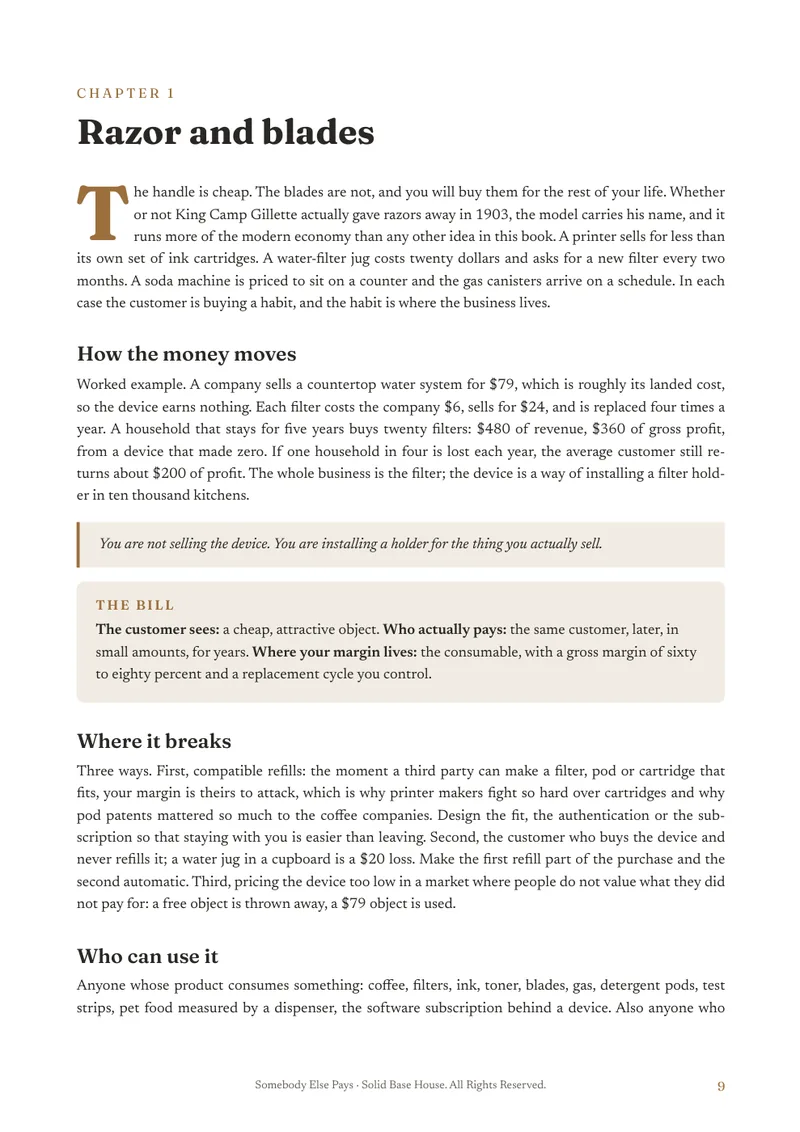
Every chapter is built the same way: the idea in a paragraph, with a company you will recognise using it; a worked example in dollars; a box headed The bill, which answers what the customer sees, who actually pays and where your margin lives; where the model breaks; and three things to do now. The appendices give you a chooser to match a model to what you already have, a one-page unit-economics sheet, seven tests to run before you give anything away, and a ninety-day launch.
Who it is for
Owners of small and mid-sized businesses whose margin is being squeezed, founders choosing a model before they build, advisors who need a plain vocabulary for ‘how does this make money’, and anyone who has looked at a free product and wondered who is paying. It assumes no finance background; the arithmetic is on the page.
What changes after you read it
Four things you will be able to do by next week
Name who pays
For any free product you see, including your competitors’, say in one sentence what the customer sees, who actually pays, and where the margin lives.
Pick your three models
Appendix A matches what you already have, a consumable, a list, idle capacity, a lease, a trade, to the chapters that fit, and your biggest constraint to the models that solve it.
Run the numbers before you spend
One page: cost to give one away, back-end margin per month, payback in months, and the partner’s side of the deal. If it does not work for one customer, it will not work for a thousand.
Launch in ninety days with ten customers
The plan in Appendix D: the paper, the partner, the ten, the numbers. Spend on the ten customers, not on the brand.
Inside the book
Seven parts, fifty models, four appendices
- IThe thing is free. The refill pays. (models 1 to 8)
- IIA bank, an insurer or an advertiser pays (models 9 to 16)
- IIIThe customer pays first, and gladly (models 17 to 24)
- IVGive away the tools, take a slice of the money (models 25 to 31)
- VOwn none of it, sell all of it (models 32 to 38)
- VISomebody else’s space, somebody else’s customers (models 39 to 45)
- VIISpace, people and what you know (models 46 to 50)
Show all 50 models
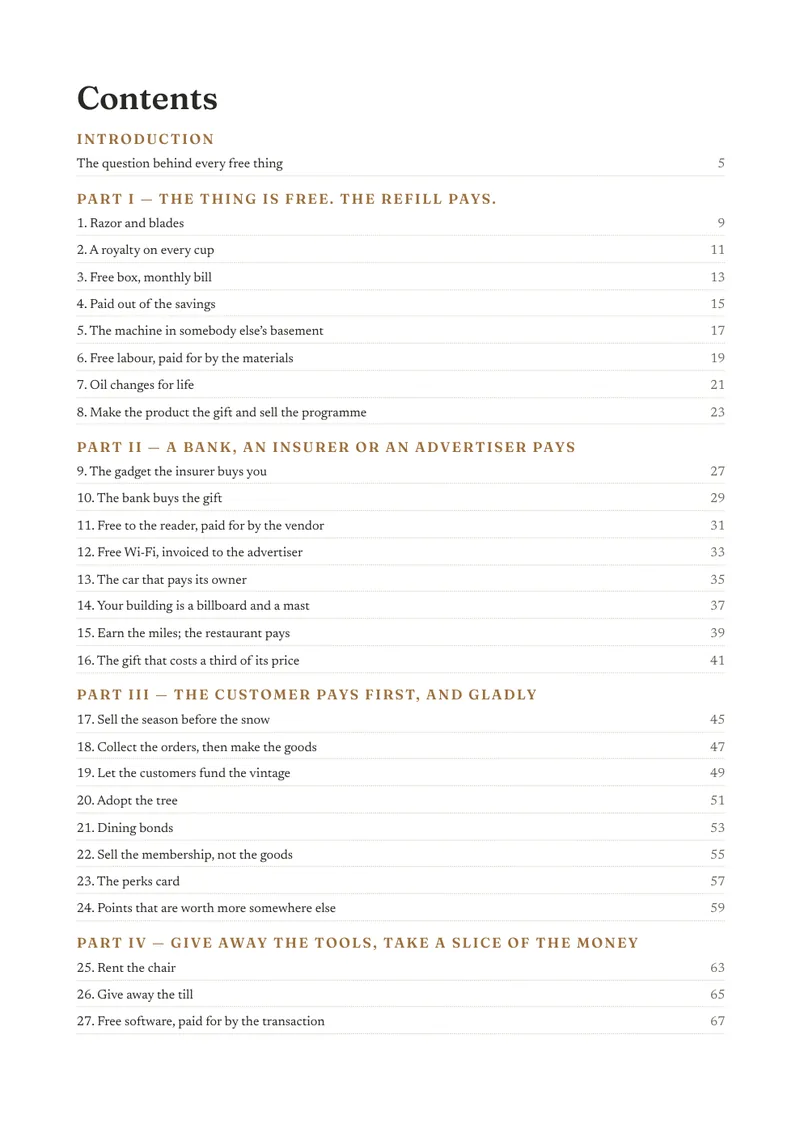
- 01Razor and blades
- 02A royalty on every cup
- 03Free box, monthly bill
- 04Paid out of the savings
- 05The machine in somebody else’s basement
- 06Free labour, paid for by the materials
- 07Oil changes for life
- 08Make the product the gift and sell the programme
- 09The gadget the insurer buys you
- 10The bank buys the gift
- 11Free to the reader, paid for by the vendor
- 12Free Wi-Fi, invoiced to the advertiser
- 13The car that pays its owner
- 14Your building is a billboard and a mast
- 15Earn the miles; the restaurant pays
- 16The gift that costs a third of its price
- 17Sell the season before the snow
- 18Collect the orders, then make the goods
- 19Let the customers fund the vintage
- 20Adopt the tree
- 21Dining bonds
- 22Sell the membership, not the goods
- 23The perks card
- 24Points that are worth more somewhere else
- 25Rent the chair
- 26Give away the till
- 27Free software, paid for by the transaction
- 28The wholesaler who runs your shop for nothing
- 29Pay the salesforce only when it sells
- 30Cash back that the merchant funds
- 31Charge for the result
- 32The dispatcher
- 33Own no gyms, sell every gym
- 34Give away the advice, sell the inputs
- 35Own the asset, hire the operator
- 36Rent the gaps
- 37The farm stay that sells the farm
- 38Rent out what you already own
- 39A counter in somebody else’s shop
- 40Borrow a channel that already has your customer
- 41The hotel room is the showroom
- 42Your customer’s living room is the showroom
- 43Idle capacity, given to somebody else’s best customers
- 44The shop with nobody in it
- 45Sell the meal to the gym’s member
- 46Cut the space smaller and the rent goes up
- 47The landlord who takes a percentage
- 48Free training, paid for by the employer who needs you
- 49The user is not the buyer
- 50Turn your trade into a classroom
- AThe model chooser: by what you have, by your constraint
- BThe one-page unit economics
- CSeven tests before you give anything away
- DThe ninety-day launch
The question behind every free thing
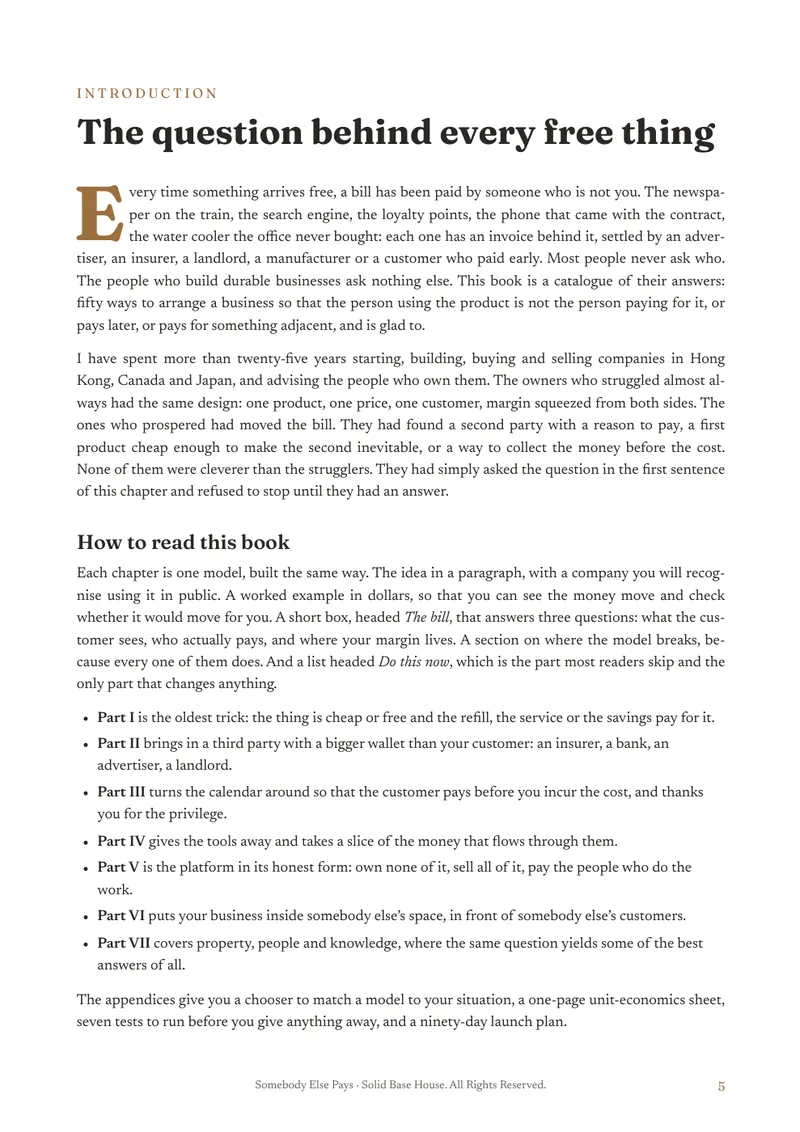
Every time something arrives free, a bill has been paid by someone who is not you. The newspaper on the train, the search engine, the loyalty points, the phone that came with the contract, the water cooler the office never bought: each one has an invoice behind it, settled by an advertiser, an insurer, a landlord, a manufacturer or a customer who paid early. Most people never ask who. The people who build durable businesses ask nothing else.
The owners who struggled almost always had the same design: one product, one price, one customer, margin squeezed from both sides. The ones who prospered had moved the bill. They had found a second party with a reason to pay, a first product cheap enough to make the second inevitable, or a way to collect the money before the cost. None of them were cleverer than the strugglers. They had simply asked the question and refused to stop until they had an answer.
Get the book
Start asking who pays
The complete PDF
US$49.99One payment. PDF, yours to keep.
All fifty models, the chooser, the unit-economics sheet, the seven tests and the ninety-day launch. 132 A4 pages, typeset to read on a tablet or print. Delivered by email.
Buy the bookBook + 45-minute model-fit call
US$299.99
The PDF plus a private call with the author. You send your filled-in unit-economics sheet and three candidate chapters; on the call you choose the model your cash, your customers and your market can carry, name the partner who pays, and leave with a written ninety-day plan.
Book the callSeven-day guarantee
If the first ten chapters don’t change how you look at your own business, reply to the delivery email within seven days and the price is refunded. Keep the PDF.
Both options are sold through Payhip’s secure checkout. The PDF downloads instantly; after buying the call, you pick a time on the booking calendar.
When you want a second opinion
Work directly with the author
Ludovic Chan has spent more than 25 years in business and consulting, and has built and sold more than a dozen companies in Hong Kong, Canada and Japan. If you want help choosing between three models, writing the proposal that gets a partner to say yes, or pricing the back end so that the front end can be free, the advisory page explains how he works and what it costs.
Before you buy
Questions readers ask
Is this about tech platforms and apps?
Mostly not. A third of the models need no software at all: a florist’s counter in a café, a landlord taking a percentage, a farm selling the season in February, a dealer’s free oil changes. Where software is involved, the book treats it as a tool, not as the business.
Are the examples real companies?
Yes, where a company has used the model in public: Costco, Keurig, ADT, Sunrun, ClassPass, Square, Faire, Rakuten, Naked Wines, Carvertise and others are named as illustrations. The worked numbers are composites in US dollars, labelled as examples, so that you can see the money move and check it against your own.
Does it work outside the United States?
Yes. The examples come from the US, Canada, Britain and Europe, and the models are international. Where one touches consumer credit, insurance introductions, deposits, personal data or tenancy law, the chapter says so and tells you to check the rules where you live.
Why US$49.99 for a PDF?
Because it is a reference you will open fifty times, not a book you read once. One model applied to one business pays for it on the first customer, and the model-fit call is priced so that the book is the cheap part. If the first ten chapters don’t change how you look at your business, you have seven days to ask for the money back.
Is this the ‘everything free, get rich from rebates’ kind of book?
No. The introduction names the models the book refuses: full-rebate schemes, deposit-taking with promised returns, gadget-for-investment rebates, guaranteed-profit franchise deposits and recruitment ladders, where the payer is always the next customer. Every model inside has a payer who receives something real.
Can I get help choosing a model for my business?
Yes. The book-and-call option includes a private 45-minute model-fit call with the author. For a model designed and launched with you over four weeks, Solid Base House offers fixed-fee advisory.