One Person, Ten Jobs
How to run a whole business alone, with AI doing the work of a team
Sound familiar?
You are faster than you have ever been. Your income has not moved.
This book is about the things that still carry a price now that fluency is free: an audience that comes back, a product with a business model underneath, a pipeline that runs without you, and the judgment to know which of the thousand things the machine can produce is the one worth producing. It shows one person doing what used to take a department, with a roster of AI staff doing nine jobs of ten.
A folder of prompts and no business
You write, summarise and plan faster than anyone you know. So does everybody else now, which is why nobody pays for it.
Tools, but no staff
You use a free model for everything, treat every new tool as a subject to study, and have never let one build something that earns.
Everything is possible and nothing gets finished
A channel, an app, an automation, a newsletter. The machine will start any of them in an afternoon, and that is the problem.
The rules you have not read
Monetisation policies, copyright, account limits, disclosure, data protection. Each one is enforced without appeal, usually after you start to earn.
The book
Writing is free. Summarising is free. Planning is free. The money moved to the people who build around the tool.
Two people came to me in the same month with the same question, and the difference between them is the reason this book exists. The first had spent a year with the best AI tools money could buy. He had a folder of four hundred prompts, sorted by category, several of them genuinely clever. He wrote faster than anyone I know, summarised faster, planned faster. His income had not changed by a dollar. The second had used AI for roughly the same length of time and could not have told you what a prompt was. She had a channel that paid her a few thousand dollars a month in advertising revenue, a small piece of software that forty strangers paid for, and a pipeline that produced and published her content while she slept. She had built three things, and the AI had built them with her. He had collected four hundred ways of asking.
Part I makes the argument: what the tools flattened, what they did not, why to pay for the best model and use one deeply, and the one job the machine cannot do. Parts II, III and IV are the three machines, in the order most people should attempt them. The content machine is a channel, mostly on YouTube, because it is the one platform that pays a revenue share at scale and because AI video is still early enough that plain work beats talent. The product machine is software, a site or an app with paying users, and it begins, deliberately, with selling somebody else’s product. The pipeline machine is automation that does a job end to end, sold to clients or built into a business you already own.
Part V is how operators actually work: a day with the staff, the knowledge base that makes a model know your business, the nine habits of the people who get paid, and an honest map of where the big money is and is not. Part VI is fifty plays: fifty short accounts of a real problem solved with a model in an afternoon, each with the brief that solved it. Six appendices give you the brief, the channel launch checklist, the two-week product launch, the workflow design sheet, the fourteen lines the methods run close to with the lawful shape of each, and a glossary.
Who it is for
Freelancers, solo founders, small-business owners and employees who want a second income, and who have used AI enough to be fast but not enough to be paid. If you have a folder of prompts and no income from them, this is the book.
What changes after you read it
Four things you will do differently this month
Choose one machine
Content, product or pipeline, matched to your position, skills and hours, with a ninety-day number attached and the first ten actions in order.
Staff the roster
A thinking partner, a researcher, a builder, a reviewer, a tutor, a secretary and an art department, one tool per role, paid for, and told everything.
Build the knowledge base
Plain files on your own machine that a model can read, so that the next proposal, script or plan knows your business instead of guessing.
Read the rules once, properly
The lines your plan runs close to, the rule for each, and the lawful shape, before the platform fixes the plan for you.
Inside the book
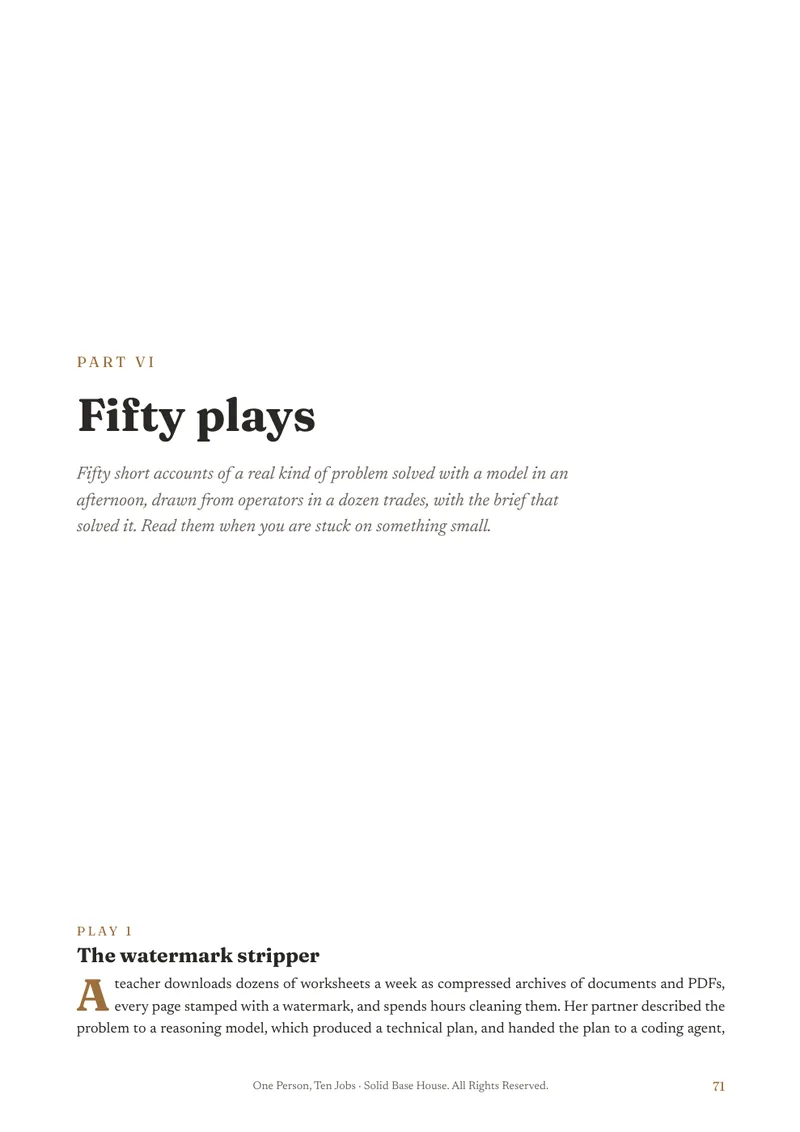
Six parts, twenty-six chapters, fifty plays, six appendices
- IThe argument
- IIThe content machine
- IIIThe product machine
- IVThe pipeline machine
- VHow operators actually work
- VIFifty plays
Show all 26 chapters
- 01Prompts don't pay
- 02The three machines
- 03Staff, not tools
- 04The judgment layer
- 05Why the money is on YouTube
- 06A hit is a body and a soul
- 07The script that stops people thinking
- 08The production line
- 09Small languages, deep niches, other money
- 10The channel matrix
- 11Content with a pulse
- 12Build a business, not an app
- 13Sell someone else's product first
- 14Where supply and demand break
- 15The first dollar, and the first thousand
- 16Three levers of growth
- 17From tool to agent
- 18The workflow is the product
- 19Selling workflows
- 20The content factory
- 21Rebuild the process, do not retrofit it
- 22The agent inside the business
- 23A day with the staff
- 24The knowledge base
- 25Habits of the people who get paid
- 26Where the big money is, honestly
- AThe brief
- BThe channel launch checklist
- CThe two-week product launch
- DThe workflow design sheet
- EThe lines
- FGlossary
Show the 50 plays
- 01The watermark stripper
- 02The calculator nobody had built
- 03The tutor that never gives the answer
- 04The examiner you cannot cheat
- 05The voice note that becomes a calendar entry
- 06The drawing audit
- 07The supplier price table
- 08The legal letter and the ninety percent
- 09The flashcards that sold ten ways
- 10The board of advisers
- 11Three futures
- 12The sales FAQ in three days
- 13The teaching assistant that never sleeps
- 14The interview analyst
- 15The audit guide in two hours
- 16The lecture that became six products
- 17Four assistants for one student
- 18The reference collector
- 19The podcast you make for yourself
- 20The earbuds that were for sleeping
- 21The tile showroom in a photo
- 22The compressor
- 23The extension that says "done"
- 24The order sheet for an aunt
- 25The diet that finally worked
- 26The parts list
- 27Two insurance quotes
- 28The answer-engine monitor
- 29Emails to a client in another language
- 30The spreadsheet formula, by voice
- 31The chat game with a health bar
- 32The novel with a cast sheet
- 33The essay marker
- 34The coach who asks one question
- 35The five-minute review
- 36The morning sweep
- 37The domain in another language
- 38The meeting that writes its own minutes
- 39The creator with a second body
- 40The hundred headlines
- 41The outsourced dashboard
- 42The daily competitor report
- 43The playbook from a mentor's videos
- 44The factory floor that predicts its own breakdowns
- 45The project you did not have to read
- 46The thumbnail reverse-engineered
- 47The handwriting that became formulas
- 48The repo you could not install
- 49The shop system rebuilt from a spreadsheet
- 50The habit experiment
He had collected four hundred ways of asking. She had built three things.
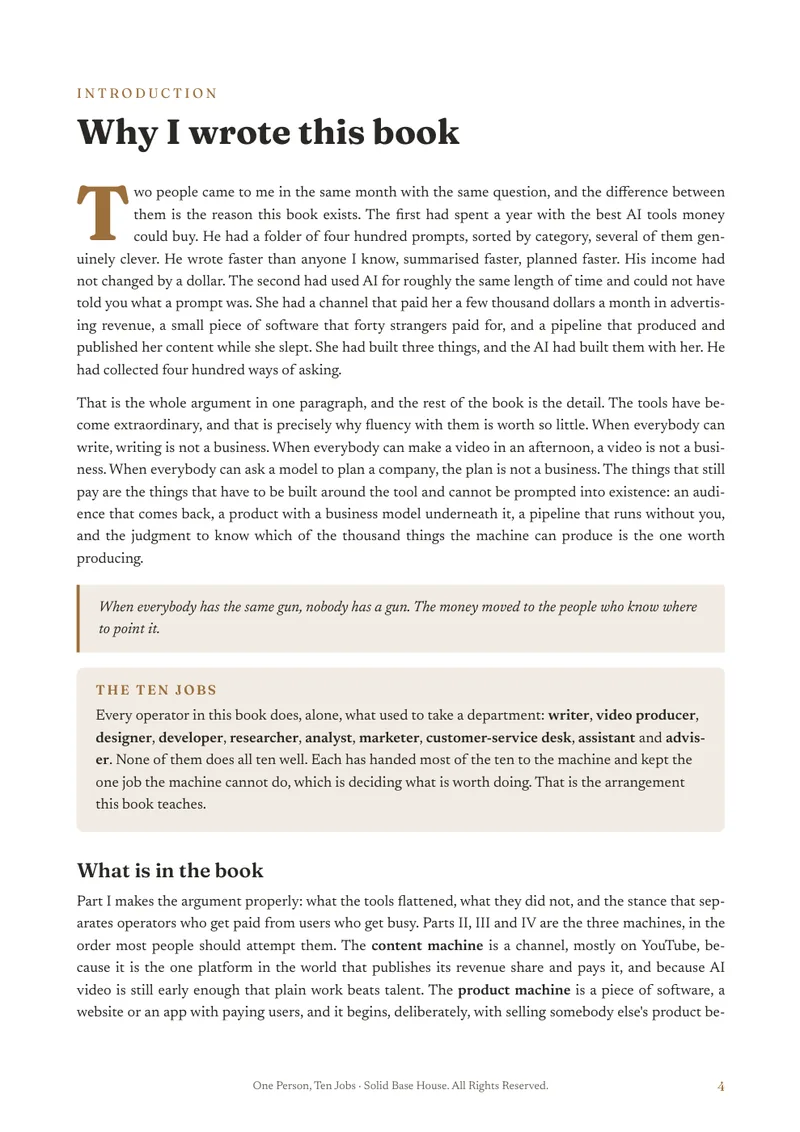
Two people came to me in the same month with the same question, and the difference between them is the reason this book exists. The first had spent a year with the best AI tools money could buy. He had a folder of four hundred prompts, sorted by category, several of them genuinely clever. He wrote faster than anyone I know, summarised faster, planned faster. His income had not changed by a dollar. The second had used AI for roughly the same length of time and could not have told you what a prompt was. She had a channel that paid her a few thousand dollars a month in advertising revenue, a small piece of software that forty strangers paid for, and a pipeline that produced and published her content while she slept. She had built three things, and the AI had built them with her. He had collected four hundred ways of asking.
That is the whole argument in one paragraph, and the rest of the book is the detail. The tools have become extraordinary, and that is precisely why fluency with them is worth so little. When everybody can write, writing is not a business. When everybody can make a video in an afternoon, a video is not a business. When everybody can ask a model to plan a company, the plan is not a business. The things that still pay are the things that have to be built around the tool and cannot be prompted into existence: an audience that comes back, a product with a business model underneath it, a pipeline that runs without you, and the judgment to know which of the thousand things the machine can produce is the one worth producing.
Get the book
Stop collecting prompts. Build the machine.
The complete PDF
US$39.99One payment. PDF, yours to keep.
All six parts, the twenty-six chapters, the fifty plays and the six appendices: the brief, the launch checklists, the design sheet, the lines and the glossary. 94 A4 pages, typeset to read on a tablet or print. Delivered by email.
Buy the bookBook + 60-minute machine-choice call
US$399.99For your own situation.
The PDF, plus a private 60-minute call with the author on which of the three machines fits your position, skills and time, the ninety-day number, the first ten actions, the roster to set up and the lines to stay behind, followed by a written one-page ninety-day plan.
Book the callSeven-day guarantee
If the book doesn’t give you one machine to build and the first ten actions to build it, reply to the delivery email within seven days and the price is refunded. Keep the PDF.
Both options are sold through Payhip’s secure checkout. The PDF downloads instantly. After buying the call, you reply to the delivery email with a few lines on your situation and pick a time on the booking calendar.
When you want a second pair of eyes
Work directly with the author
Ludovic Chan has spent more than 25 years in business and consulting, and has built and sold more than a dozen companies in Hong Kong, Canada and Japan, several of them from almost nothing. If you have a machine circled and want to know whether it fits your situation, or a process you want rebuilt as a pipeline, start with a short email.
Before you buy
Questions readers ask
Is this a book of prompts?
No. There is a six-part template for writing a brief in Appendix A and a brief under each of the fifty plays, but the book’s argument is that prompts are not where the money is. It is about the three things that still pay once everyone can prompt: an audience, a product and a pipeline, and the judgment to run them.
Which AI tools does it use?
The book names roles rather than brands: a thinking partner, a researcher, a coding agent, a reviewer, a tutor, a multimodal model, a secretary, an art department. Brands change every quarter; the roster does not. Where a category matters, such as visual workflow platforms or long-context models, the book says what to look for.
Do I need to know how to code?
No. Several of the operators in the book have no technical background and ship software by discussing the design with one model and handing a written specification to a coding agent. Chapter 25 describes how a programmer who had failed twice to learn these tools built an app in four hours on the third try, one step at a time.
Is it legal and within platform rules?
Every method is tied to a platform rule or a law somewhere, and the book says where. Chapters carry a “The line” box wherever a method runs close to monetisation policies, copyright, account limits, disclosure law, data protection or API terms, and Appendix E lists fourteen such lines with the lawful shape of each. It is a map of which door to knock on, not legal advice.
Why US$39.99 for a PDF?
Because one machine, started this quarter, is worth more than the price of the book, and because the alternative is another year of being fast and unpaid. And if the book doesn’t give you one machine to build and the first ten actions to build it, you get your money back.
What is the machine-choice call?
You send two or three lines on your situation and the machine you are leaning towards; the author then spends sixty minutes with you on whether a content, product or pipeline machine fits your position, skills and time, the ninety-day number, the first ten actions, the roster to set up and the lines your plan touches. A written one-page plan follows within three business days. It is not legal, tax or investment advice.