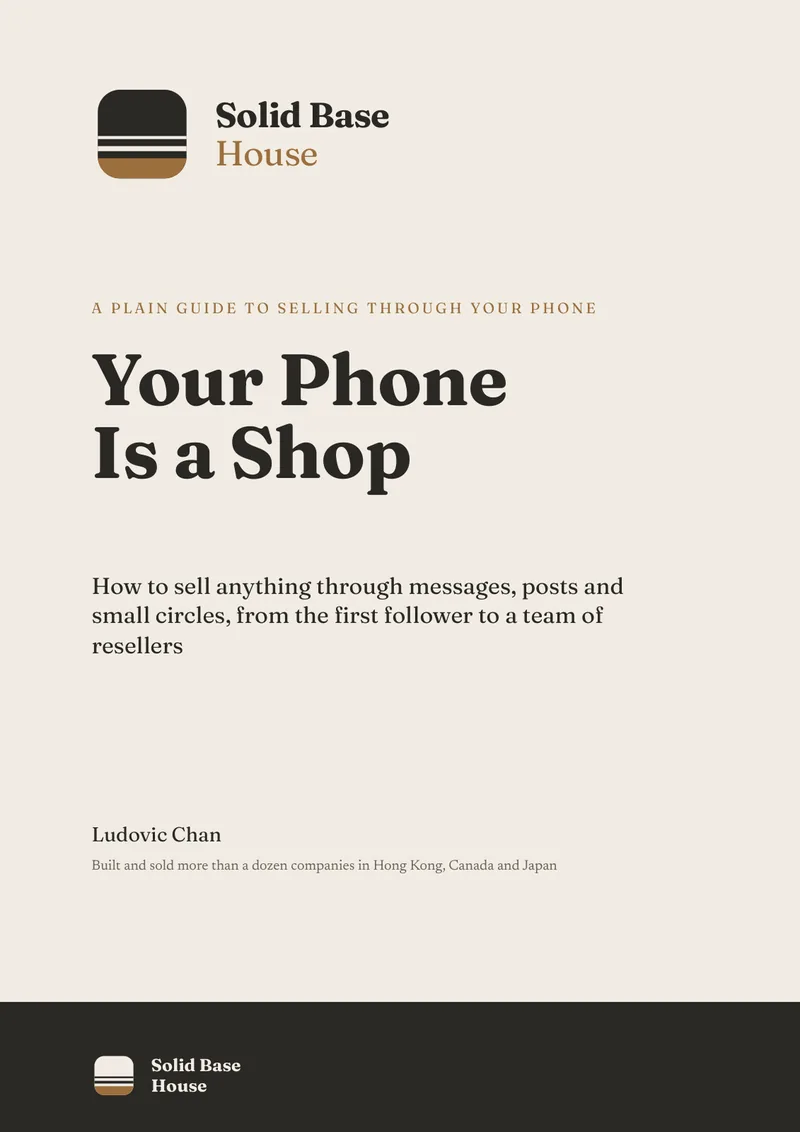
Your Phone Is a Shop
How to sell anything through messages, posts and small circles, from the first follower to a team of resellers
Sound familiar?
You sold to everyone you know. Then it went quiet.
A phone is a shop with no rent and no footfall. Every customer is someone you went out and found, and the shop stays open only as long as you keep finding them. This book is the whole trade, in order: what to put on the shelf, how to meet twenty strangers a week without buying them, how to post like a person people trust, how to sell in a conversation, how to keep the buyer, and how to grow past one phone.
Month three, nothing
Your four hundred contacts bought once, out of kindness. Now the feed is silent and you think the product was wrong. It wasn’t. The street was empty.
You post all day and sell nothing
Product shots, prices, ‘DM for details’. People mute billboards. Nobody is asking, so nobody is buying.
Every message ends in silence
‘It’s too expensive.’ ‘I’ll think about it.’ ‘Let me look around.’ You answer badly, or you don’t ask for the order at all, and the chat just stops.
The buyers never come back
You take the money and vanish until the next product post. The second order, the referral, the regular: none of it happens by itself.
The book
The whole trade of selling from a phone, in forty short chapters.
Picture a woman who starts selling skincare from her phone in January. She has four hundred people in her contacts and feeds. She posts, they are kind, and for three months it works. Then it stops. She did not do anything wrong. She did what almost everyone does with a phone shop: she harvested a field she never planted. Everything in this book follows from that picture.
Part I is the premises: what you are actually running, the seven tests for what to sell, the six honest ways a phone earns money, your name and face, and the kit. Part II is footfall: eight ways to find people who do not know you yet, every week, without buying them, and the shortcuts that end the shop. Part III is the window: posting like a person, twenty-nine days of giving to one of selling, pictures that are yours, proof you do not have to fake, timing, and headlines that earn the next line.
Part IV is the counter: from the comment to the message, the four questions before the pitch, the six objections every buyer makes and the words that answer them, closing by asking, the long post built from seventeen pieces, and words with a pulse. Part V is the regulars: the eight moments that make a customer for life, the eleven-step complaint, the five follow-ups nobody sends, circles and referrals. Part VI is growth: the honest reseller programme, the three desks that turn a phone shop into a company, groups that run a team, and the ten mistakes that close phone shops.
Who it is for
Makers with an Etsy shop and an Instagram account, resellers with a wholesale account and a WhatsApp list, consultants who sell through a newsletter, creators with an audience and no idea how to charge it, and shop owners who have noticed that half their orders now begin with a message. It assumes a phone, something worth selling and no advertising budget.
What changes after you read it
Four things you will be able to do by next week
Meet twenty strangers a week
Marketplaces as a front door, the post that makes people ask, other people’s groups, swaps and gifted product, a giveaway that filters for buyers, a QR code on everything. Pick three, do them for ninety days.
Post like a person, not a billboard
Five kinds of post in a proportion that never feels like being sold to, pictures only you could have taken, proof with permission, and the hour your readers actually look.
Answer the six objections and close
‘Too expensive’, ‘I’ll think about it’, ‘let me look around’, ‘best price’, ‘I’ll wait for the sale’, and the push past your floor: the wrong answers, the right ones, and the sentence that asks for the order.
Turn a buyer into a regular
The eight moments, the complaint handled in eleven steps, the reorder message that arrives the week the jar runs out, and a referral code that pays on one purchase, one level, no scheme.
Inside the book
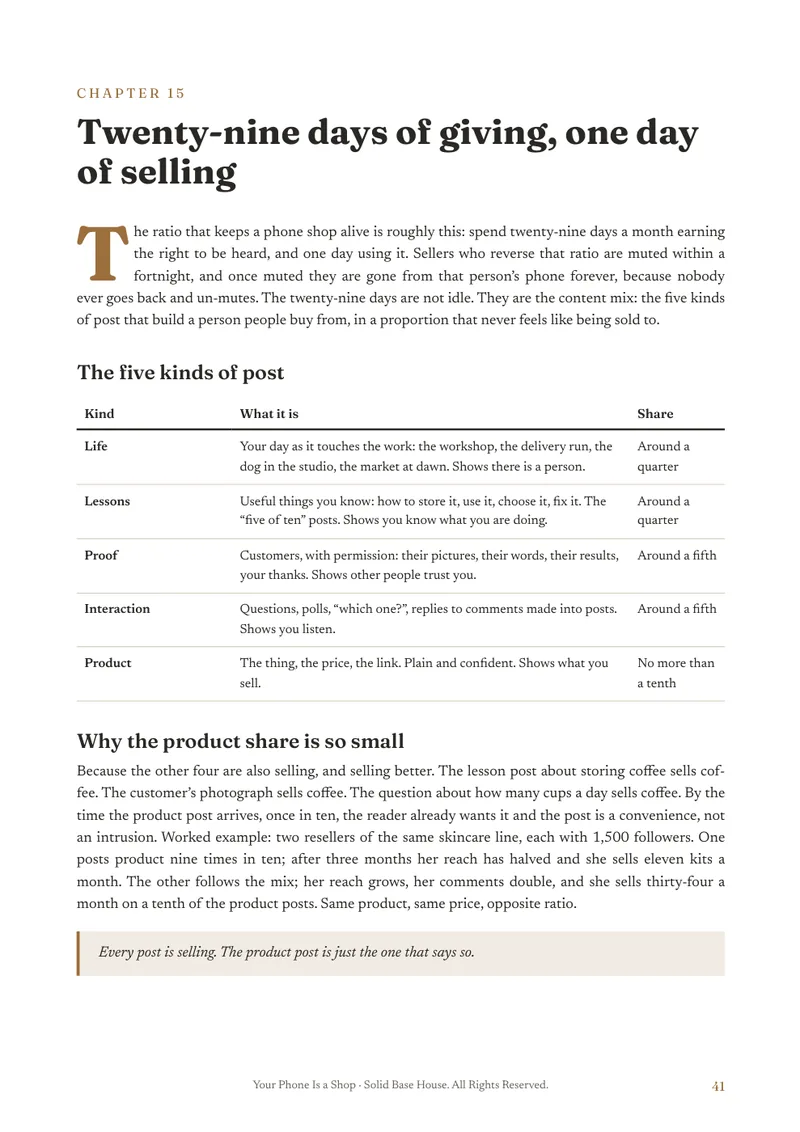
Six parts, forty chapters, five appendices
- IThe shop you are actually running (chapters 1 to 5)
- IIFinding people who do not know you yet (chapters 6 to 13)
- IIIPosting like a person (chapters 14 to 20)
- IVSelling in the conversation (chapters 21 to 31)
- VKeeping them (chapters 32 to 35)
- VIGrowing beyond you (chapters 36 to 40)
Show all 40 chapters
- 01No rent, no footfall, no excuses
- 02Choose what to sell: the seven tests
- 03Six honest ways to earn from a phone
- 04One name, one face, one line
- 05The kit: a link, a list and a notebook
- 06Plant every day
- 07Go where the buyers already are
- 08The post that makes people ask
- 09Other people’s groups, and then your own
- 10Swaps, shout-outs and gifted product
- 11The giveaway that brings buyers, not bargain hunters
- 12From the stall to the phone
- 13The shortcuts that end the shop
- 14Trust is built in public
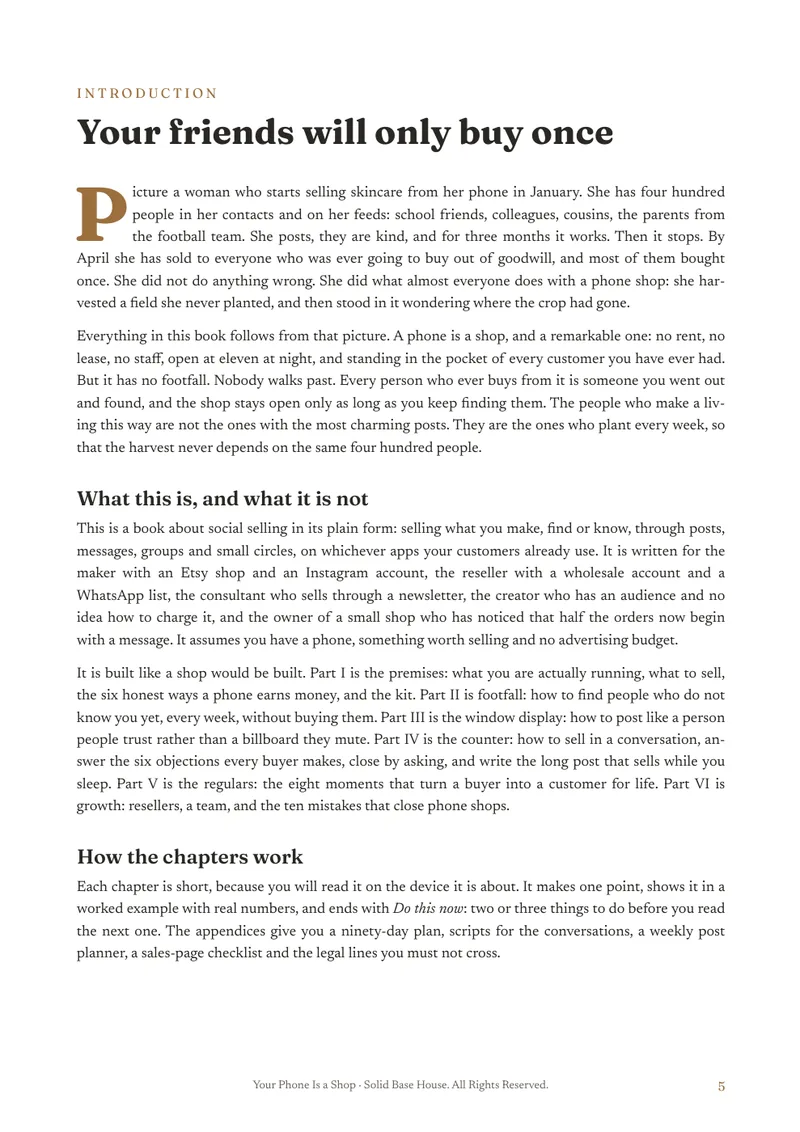
- 15Twenty-nine days of giving, one day of selling
- 16Pictures that are yours
- 17Proof you do not have to fake
- 18When to post, how often, and what never to do
- 19Interaction is the job
- 20Headlines that earn the next line
- 21From the comment to the message
- 22The four questions before the pitch
- 23“It’s too expensive”
- 24“I’ll think about it”
- 25“Let me look around first”
- 26“Just give me your best price”
- 27“I’ll wait for the sale”
- 28When they push past your floor
- 29Closing is asking
- 30The long post: a sales page in seventeen pieces
- 31Words with a pulse
- 32The eight moments that make a customer for life
- 33A complaint is a gift. Open it properly.
- 34After the sale: the follow-ups nobody sends
- 35Circles, tiers and referrals
- 36The honest reseller programme
- 37Three desks: how a phone shop becomes a company
- 38Groups that run a team
- 39Leading people who do not work for you
- 40The ten mistakes that close phone shops
- AThe ninety-day plan
- BScripts for the conversations
- CThe weekly post planner
- DThe sales-page checklist
- EThe legal lines
Your friends will only buy once
Picture a woman who starts selling skincare from her phone in January. She has four hundred people in her contacts and on her feeds: school friends, colleagues, cousins, the parents from the football team. She posts, they are kind, and for three months it works. Then it stops. By April she has sold to everyone who was ever going to buy out of goodwill, and most of them bought once.
A phone is a shop, and a remarkable one: no rent, no lease, no staff, open at eleven at night, and standing in the pocket of every customer you have ever had. But it has no footfall. Nobody walks past. Every person who ever buys from it is someone you went out and found, and the shop stays open only as long as you keep finding them.
Get the book
Open the shop properly
The complete PDF
US$39.99One payment. PDF, yours to keep.
All forty chapters, the ninety-day plan, twelve message scripts, the weekly post planner, the sales-page checklist and the legal lines. 111 A4 pages, typeset to read on a tablet or print. Delivered by email.
Buy the bookBook + 45-minute shop review
US$239.99
The PDF plus a private call with the author. You send your profile, your last thirty posts, your product page and your numbers; on the call you find the three things costing you the most sales and leave with a written list of what to change this month, in order.
Book the reviewSeven-day guarantee
If the first two parts don’t change how you run your phone shop, reply to the delivery email within seven days and the price is refunded. Keep the PDF.
Both options are sold through Payhip’s secure checkout. The PDF downloads instantly; after buying the review, you pick a time on the booking calendar.
When you want a second opinion
Work directly with the author
Ludovic Chan has spent more than 25 years in business and consulting, and has built and sold more than a dozen companies in Hong Kong, Canada and Japan. If you want help choosing what to sell, fixing a shop that posts well and converts badly, or building a reseller programme that would survive a regulator’s reading, the advisory page explains how he works and what it costs.
Before you buy
Questions readers ask
Which apps does it cover?
Whichever ones your customers use. Instagram, TikTok, Facebook groups, WhatsApp, YouTube, Pinterest, Etsy and Shopify are named where an example needs a name, but nothing depends on any of them. The methods are older than the apps: find people, be useful in public, talk in private, ask for the sale, look after the buyer, repeat.
Is this about ‘network marketing’?
No. The introduction and chapter 3 say plainly that schemes where the money comes from recruits buying stock are left out. The reseller programme in chapter 36 is one level, no joining fee, returnable stock, paid only on sales to real customers, with no income claims.
Does it work outside the United States?
Yes. The examples are from the US, Canada, Britain and Europe, and the legal appendix covers disclosure, messaging consent, giveaway rules and consumer rights as questions to check where you sell. Prices are in US dollars as worked examples only.
Why US$39.99 for a PDF?
Because one objection answered properly pays for it on the first sale, and one reorder message sent the week the jar runs out pays for it every month after. And if the first two parts don’t change how you run your phone shop, you have seven days to ask for the money back.
I have no followers yet. Is it too early?
No. Part II starts from zero: marketplaces as a front door, groups where your buyers already talk, swaps with accounts your size, a QR code at your stall. The ninety-day plan assumes you are starting this week.
Can I get help with my own shop?
Yes. The book-and-review option includes a private 45-minute call on your actual profile, posts, page and numbers. For a product or a reseller programme designed with you, Solid Base House offers fixed-fee advisory.