Free tool · from Somebody Else Pays
Business Model Finder
Start with what you already have, not with the model you liked best. Tick your assets, name your biggest problem, and get the models from Somebody Else Pays that fit both, with a payback check before you spend anything.
Free, with no sign-up. It runs in your browser, and nothing you type is sent to us.
How it works
The model chooser from the back of the book, made interactive
- Tick everything your business already has: a product that needs refills, an audience, idle space, a trade you run well.
- Choose your biggest problem: no money to start, customers who cost too much to find, thin margins, customers who leave, rent, hiring or unpredictable demand.
- Each model that builds on something you have scores three points; each that solves your problem scores two. The ones that do both rise to the top.
- Run your favourite through the payback check and the seven tests before you give anything away.
The full list
All 50 models in Somebody Else Pays
Grouped as they are in the book, from the refill that pays for the free machine to the trade that becomes a classroom.
The thing is free. The refill pays. (models 1 to 8)
- 1Razor and blades. Sell the device cheaply and earn on the refills it needs for years: filters, blades, cartridges, pods.
- 2A royalty on every cup. Own the format and license it, so every maker of compatible refills pays you a little on each unit.
- 3Free box, monthly bill. Install the equipment for next to nothing and earn on a monitoring or service contract that runs for years.
- 4Paid out of the savings. Pay for the upgrade yourself and get repaid out of the bill it cuts: energy, water, waste or downtime.
- 5The machine in somebody else’s basement. Place and service machines on other people’s premises, collect the takings and pay the host a share.
- 6Free labour, paid for by the materials. Offer the fitting, design or installation free and price it into materials the customer was buying anyway.
- 7Oil changes for life. Give a small recurring service away so the customer comes back twice a year, where the real work is found.
- 8Make the product the gift and sell the programme. Put the equipment inside a paid programme: the customer feels given something, and the errand that stopped them signing up is gone.
A bank, an insurer or an advertiser pays (models 9 to 16)
- 9The gadget the insurer buys you. Get an insurer, utility or employer to pay for your device, because it cuts losses they would otherwise pay for.
- 10The bank buys the gift. Let a bank, card company or financial firm pay for a gift to your customers in return for the introduction.
- 11Free to the reader, paid for by the vendor. Give readers or users the product free and charge the businesses that want to reach them.
- 12Free Wi-Fi, invoiced to the advertiser. Provide a free service in a busy place and charge advertisers or sponsors for the attention it gathers.
- 13The car that pays its owner. Turn something people already own and move around into advertising space, and split the fee with them.
- 14Your building is a billboard and a mast. Lease the roofs, walls, lifts and parking you control to networks, advertisers and apps.
- 15Earn the miles; the restaurant pays. Reward diners or shoppers with points the merchant pays for, and take a share of every visit you send.
- 16The gift that costs a third of its price. Give customers a perk they value at retail but you buy at wholesale, and let it keep them from leaving.
The customer pays first, and gladly (models 17 to 24)
- 17Sell the season before the snow. Sell season passes or shares of the harvest months ahead: cash before costs, and a crowd you can count on.
- 18Collect the orders, then make the goods. Take payment first, then buy and build, so growth produces cash instead of eating it.
- 19Let the customers fund the vintage. Members deposit a monthly sum that you use to pay producers in advance, in return for better prices for the members.
- 20Adopt the tree. Sell a named share of next year’s harvest: a tree, a hen, a row of vines, with a visit included.
- 21Dining bonds. Sell credit now that is worth more later: customers lend you cash and are repaid in what you sell.
- 22Sell the membership, not the goods. Price the goods close to cost and make the profit on the yearly membership fee.
- 23The perks card. Sell a card of benefits that merchants supply free because they want the customers it brings.
- 24Points that are worth more somewhere else. Issue loyalty points that partners honour at a premium, so customers stay and partners gain visits.
Give away the tools, take a slice of the money (models 25 to 31)
- 25Rent the chair. Fit out a space and rent it by the week to independents who bring their own clients and keep their own takings.
- 26Give away the till. Give the terminal or software away and earn on every payment, loan and add-on that flows through it.
- 27Free software, paid for by the transaction. Drop the subscription and take a small percentage of the bookings and payments your software handles.
- 28The wholesaler who runs your shop for nothing. Give independent shops branding and systems for nothing, in exchange for buying their stock through you.
- 29Pay the salesforce only when it sells. Use commission-only representatives, affiliates and wholesale marketplaces: no sale, no cost.
- 30Cash back that the merchant funds. Pass most of a merchant’s affiliate commission back to shoppers as cash back, and keep the rest.
- 31Charge for the result. Charge nothing up front and take a share of the result: the win, the hire, the saving.
Own none of it, sell all of it (models 32 to 38)
- 32The dispatcher. Own the customer and the booking, send the job to a network of independent professionals, and keep a margin.
- 33Own no gyms, sell every gym. Sell one pass to many venues' spare capacity, and pay them per visit for places that would have stayed empty.
- 34Give away the advice, sell the inputs. Give a trade free tools and advice, then supply what it buys at a margin.
- 35Own the asset, hire the operator. Let investors own the property while you run it under your brand for a fee and a share of profit.
- 36Rent the gaps. Rent empty shops, studios or kitchens by the day for pop-ups, shoots and events.
- 37The farm stay that sells the farm. Let people stay or visit free when they are likely to buy, and sell them the produce on the way out.
- 38Rent out what you already own. Rent out idle things (a car, a pool, a garage, equipment) by the hour or the day.
Somebody else’s space, somebody else’s customers (models 39 to 45)
- 39A counter in somebody else’s shop. Trade from a counter inside somebody else’s premises: no lease, and no footfall to buy.
- 40Borrow a channel that already has your customer. Sell through a partner whose customers already trust them, and give the partner a share.
- 41The hotel room is the showroom. Put your product where people use it for a night, then sell it to them.
- 42Your customer’s living room is the showroom. Pay happy customers a small fee to host viewings of what they bought.
- 43Idle capacity, given to somebody else’s best customers. Give empty seats or quiet hours to a partner’s best customers, who then spend on everything else.
- 44The shop with nobody in it. Run an unstaffed shop: a smart vending wall, an office snack shelf, a self-service store open round the clock.
- 45Sell the meal to the gym’s member. Give a host a free tool for its members that recommends your product, and share the revenue with the host.
Space, people and what you know (models 46 to 50)
- 46Cut the space smaller and the rent goes up. Divide a big space into small units and let them at a higher rate per square foot.
- 47The landlord who takes a percentage. Swap part of a fixed rent for a share of sales, to fill a building and raise what it is worth.
- 48Free training, paid for by the employer who needs you. Train people for free and get paid by the employers who need them, or by a period of work for you.
- 49The user is not the buyer. Sell to the person with the money (the parent, the employer, the carer), not to the person who uses it.
- 50Turn your trade into a classroom. Teach others how you run your trade: workshops, courses and consulting.
The book behind the tool
Fifty ways to get paid where the customer never sees the bill
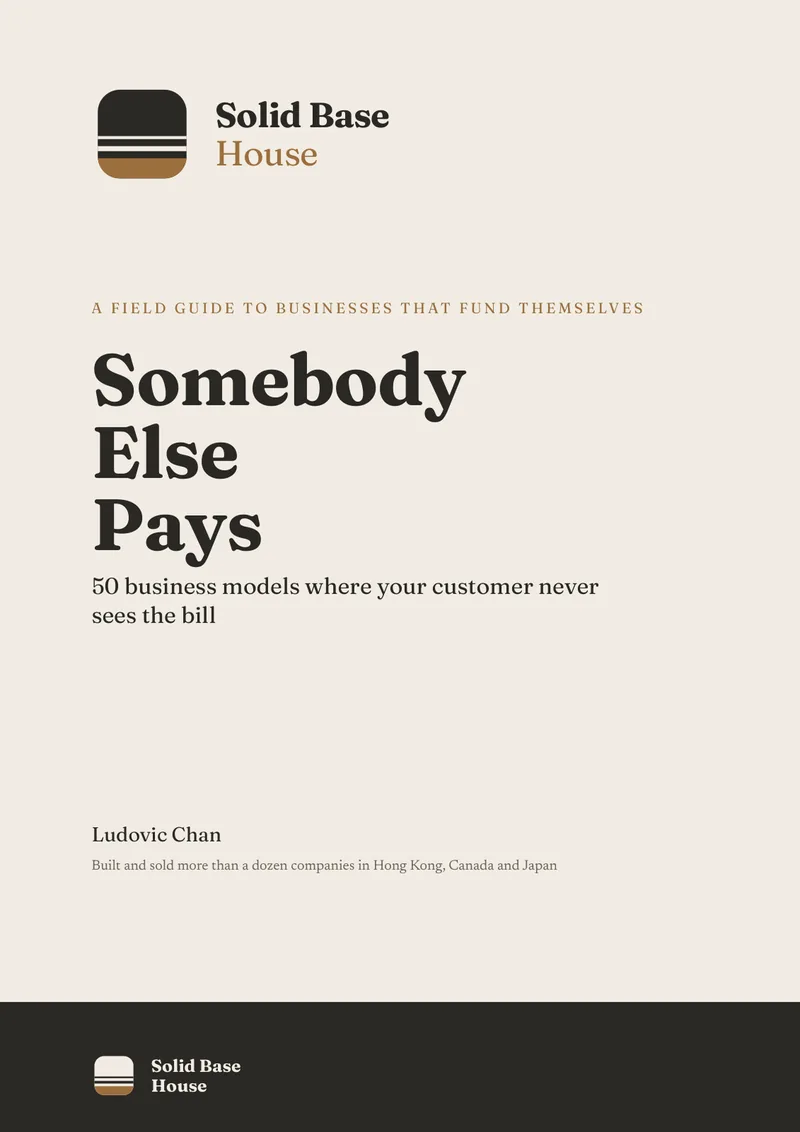
Somebody Else Pays covers fifty business models: razor and blades, insurer-funded gadgets, season passes, free tills, rented chairs. Each comes with worked numbers, the condition that makes it work and the way it fails. This finder is the book’s Appendix A; the payback check is Appendix B; the seven tests are Appendix C.
Buy the PDF · US$49.99 About Somebody Else Pays
Seven-day guarantee. Instant download through Payhip's secure checkout.
Two companion books go further: Lose Money on Purpose (seventy models where the product is free and the profit is elsewhere) and Everything Is for Sale (seventy-two ways to turn what a business already has into cash).
A second pair of eyes
Want help choosing, and checking the numbers?
Each model book has an optional call with the author, built around its worksheet.
Book + 45-minute model-fit call
US$299.99
The PDF plus a private call with the author. You send your filled-in unit-economics sheet and three candidate chapters; on the call you choose the model your cash, your customers and your market can carry, name the partner who pays, and leave with a written ninety-day plan.
Book + 60-minute model design call
US$399.99
The PDF, plus a private 60-minute call with the author on your completed worksheet: the carrier product and its condition, the attachment, the back end, the three winners, the two numbers to test, and the legal line, followed by a written one-page model you can build from.
More free tools
Other tools from the same shelf
Cost Per Use Calculator
From The Poor Pay Twice
Is the expensive one really cheaper? Compare two buys over the years, with repairs and resale, and see the cost per use.
Open the toolOver-Explaining Checker
From Rich People Don’t Explain
Paste an email. See every apology, hedge and justification highlighted, get a directness score and a plainer draft.
Open the toolObjection Reply Builder
From Your Phone Is a Shop
Choose what the buyer said. Get honest replies for a message, an email or a call, plus what not to say.
Open the toolQuit Your Job Calculator
From Nobody Is Coming to Promote You
Six months at 75% of your pay, six months of savings, more customers than time. See which you have, and when the rest arrives.
Open the toolQuestions
Business models, answered
What is a business model?
The way a business turns what it does into money: who pays, for what, how often, and why they pay you rather than someone else. Two businesses selling the same product can have completely different models. One sells the machine; the other gives it away and sells the refills.
How does the finder choose models?
It uses the model chooser from Somebody Else Pays. Each model is listed against the assets it builds on and the problems it solves. Your answers score every model, and the ones that match both what you have and what is holding you back come first.
What is a good payback period?
The book’s line is eighteen months: the money that comes in afterwards should repay what the free or cheap front end cost within a year and a half, after allowing for customers who never buy anything else. Under eighteen months, a model can fund its own growth. Over it, redesign before you launch.
What does “the story is better than the business” mean?
It is the book’s warning for models whose lifetime margin is less than three times what it costs to win each customer. They sound clever and look good on a slide, but one wrong guess about churn or cost and they lose money.
Are these models legal everywhere?
Most touch a regulated area: consumer credit, deposits, insurance introductions, personal data, franchising or tenancy. The fifth of the seven tests is an hour with a lawyer who knows your field, where you trade, before launch.
Do I need the book to use the finder?
No. The finder, the one-line descriptions and both checks are free. The book adds the worked numbers, real examples, the conditions that make each model work and the ways each one fails.